How to Build a Knowledge Base Chatbot Your Employees Will Actually Use
Most enterprise wikis are warehouses with no index. Employees open a browser, type a question, and get back a wall of outdated PDFs, a Slack thread from two years ago, and a SharePoint folder nobody has touched since the last reorg. They spend minutes, sometimes far longer, hunting for a policy that should take ten seconds to locate, then give up and interrupt a colleague instead.
A modern knowledge base chatbot built on Retrieval-Augmented Generation (RAG) eliminates that friction entirely. Think of your traditional wiki as a massive, unindexed warehouse where every employee has to walk every aisle themselves. A RAG-enabled chatbot is the expert librarian who already knows every shelf, handing you the exact page before you finish asking.
Ovidius AI builds these systems for enterprises across industries, delivering working solutions in under 30 days. This is not a conceptual framework: it is a deployed, integrated, employee-facing assistant. We build for adoption.
The information bottleneck is real. Employees across organizations routinely lose significant portions of their workday navigating fragmented internal documentation: time that compounds across teams into a measurable drag on operational throughput.[¹]
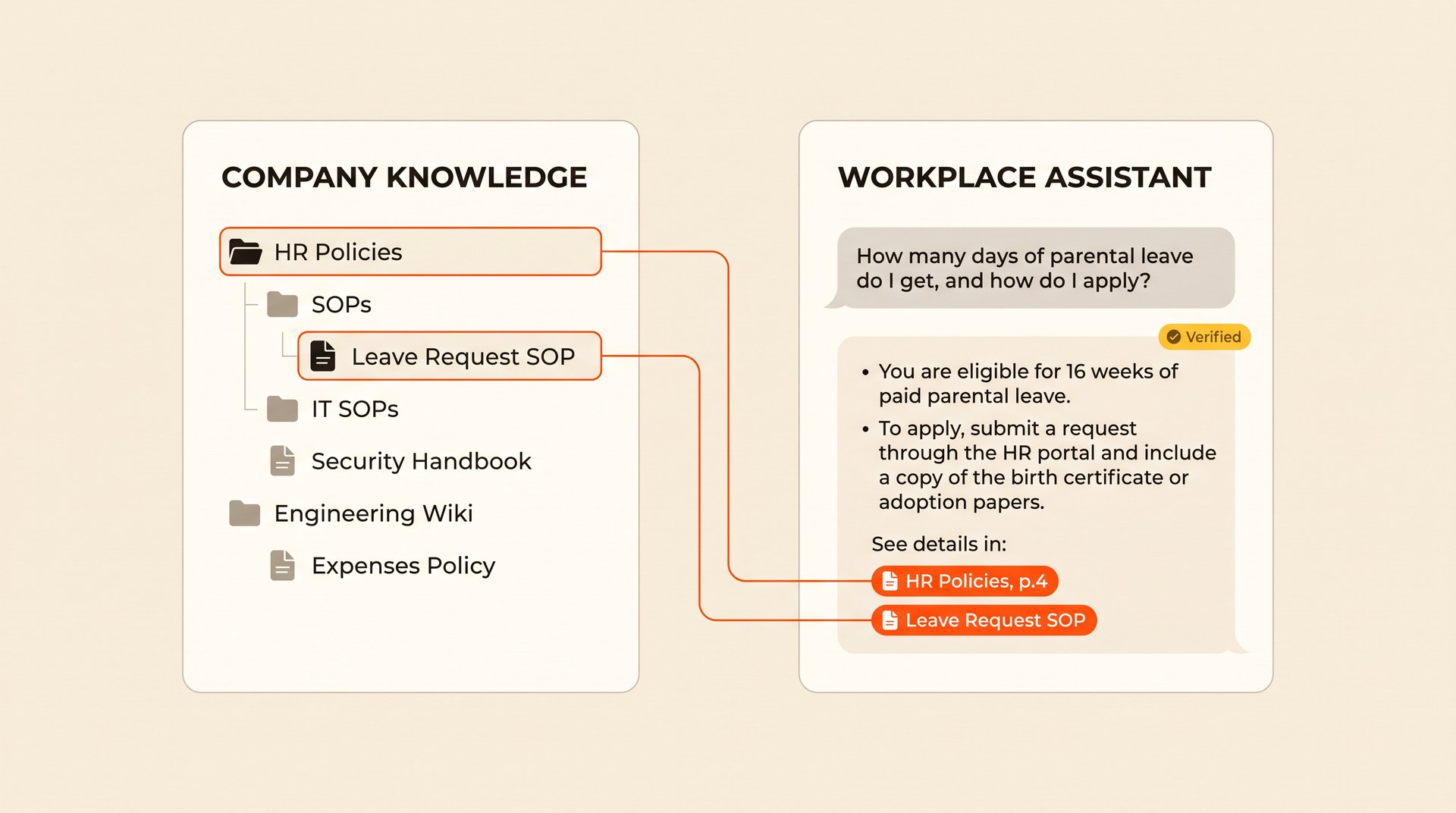
The enterprise context layer is where the architecture either holds together or falls apart. Before any LLM processes an employee query, your documents must be ingested into a unified, governed knowledge graph: chunked, tagged, and indexed so the retrieval layer can surface precise context on demand. RAG works by pulling verified source passages and feeding them to the model as grounded input, which means the system generates its answer from your actual documentation rather than from its training weights. Hallucinations drop sharply because the model is constrained to what it can retrieve. Chatbot accuracy, then, is not primarily a function of which LLM you select: it is a direct reflection of how rigorously your documents were ingested and governed.
Why Traditional Employee Self-Service Fails (And How to Fix It)
Keyword-based search engines fail employees who don't know the exact terminology baked into a policy document. An employee asking "can I expense a client dinner?" won't surface the Travel & Entertainment Policy if it's filed under "T&E Reimbursement Guidelines." Semantic search resolves that mismatch: it understands query intent rather than lexical overlap, and can retrieve the right document even when the wording diverges entirely. Deploying semantic retrieval doesn't just accelerate search; it removes the entire category of "wrong search term" failures that cause employees to abandon self-service tools in the first place.
Adoption collapses the first time a chatbot delivers a confident, wrong answer. One fabricated policy detail, one invented deadline, and employees stop trusting the tool entirely. Trust is fragile. The fix is architectural: configure the system to return a graceful "I don't have a confident answer for this" and route the query directly to an internal ticket or human agent, rather than generating a plausible-sounding guess. Accuracy gates and confidence thresholds are not optional refinements; they are the foundation of sustained adoption. Structured pipelines that enforce these constraints, like the multi-agent AI content pipeline Ovidius AI deployed for GoKickflip, demonstrate how measurable accuracy outcomes follow from deliberate pipeline design.
Every answer the chatbot delivers should carry a direct citation: "According to page 4 of the 2026 Travel Policy..." with a hyperlink to the source document. This is non-negotiable for any enterprise-grade AI chatbot for internal documentation. Employees need to verify answers independently: not because they distrust AI in principle, but because the stakes of acting on a misread policy are real. Citations dissolve the "black box" anxiety that kills adoption and give your governance team an auditable trail of what the system is surfacing.
Step-by-Step: How to Build an Internal AI Chatbot Your Team Will Trust
You don't need a perfectly organized document library before you start. Start small. Begin with a phased ingestion strategy: target your highest-traffic FAQs and HR policies first, then expand. Documents are broken into chunks, typically 400 to 600 tokens with overlap between segments, and tagged with metadata (document type, department, effective date, version) so the retrieval layer can locate the right context even across a large corpus. A structured ingestion checklist covering formatting standards, chunking parameters, and metadata taxonomy is the operational backbone of this phase.
Step 3: Core Deployment Best Practices
- Establish Human-on-the-Loop Governance: Assign clear document owners who update source files when policies change. The chatbot is only as current as its last ingestion.
- Deploy on Existing Channels: Integrate directly into Slack, Microsoft Teams, or your intranet. Employees won't adopt a tool that demands opening a separate application.
- Define Clear Escalation Paths: When the bot can't return a confident answer, route the query directly to an internal ticket or a live HR/IT agent.
- Rigorous Pre-Launch Testing: Score the bot against a set of real, historical employee questions before company-wide rollout. Accuracy benchmarks should be set and met before launch, not after.
Choosing between self-hosted AI workflows, off-the-shelf SaaS, and a custom-built solution involves substantial trade-offs. Rigid SaaS tools deploy quickly but rarely accommodate the document structures, permission hierarchies, and integration requirements of a mature enterprise. A DIY build offers full control but demands months of engineering time and carries significant accuracy risk if RAG pipeline design isn't a core competency in-house. Ovidius AI's 30-day delivery model occupies the practical middle ground: custom-built to your document architecture, integrated into your existing tooling, and deployed faster than most internal IT projects clear their first approval gate.
Query resolution rate, average search time saved, and employee adoption rate are the three metrics that translate chatbot performance into language finance and operations teams recognize. A 40% reduction in triage time means your HR or IT team reclaims real hours each week, hours previously consumed by answering the same ten questions on rotation. Track these from week one, not as an afterthought. Usage data also surfaces which document categories generate the most unresolved queries, giving you a prioritized path for documentation improvement.
Imperfect documentation is not a blocker. A structured ingestion pipeline can process messy files, such as inconsistent formatting, mixed PDF and Word sources, or legacy naming conventions, while the chatbot's own query logs identify exactly which documents need updating most urgently. Waiting for perfect documentation before building is the operational equivalent of waiting for a clean inbox before writing an important email. Start with what you have, instrument the system to surface gaps, and improve iteratively.
Build Your Custom Internal Knowledge Base Chatbot in 30 Days
Building a knowledge base chatbot that employees consistently use comes down to three things: strict RAG governance over your source documents, integration into the channels where work already happens, and a 30-day delivery timeline that doesn't outlast organizational patience. Ovidius AI delivers on all three. Fragmented internal documentation is an operational hazard: partner with a team that builds alongside you as an extension of your team and ships working solutions in under 30 days.
Ready to eliminate internal search bottlenecks and boost employee productivity? Book an enterprise AI audit with Ovidius AI today. We'll map your internal processes, rank your chatbot use cases by tangible ROI, and deliver a clear implementation plan. Our team builds custom, high-accuracy RAG pipelines integrated directly into your existing tools. We deliver results.
"From day one, the Ovidius team moved fast, thought big, and executed with precision. Together, we built something truly cutting-edge that will be a major benefit for our business." - Renaud, Founder & CEO, GoKickflip
Footnotes
[1] GAP: The average daily hours an employee spends searching for internal information is currently an unverifiable statistic.
[2] GAP: The specific success rate of traditional employee self-service tools according to Gartner is currently an unverifiable statistic.
[3] GAP: The original RAG research paper title and authors demonstrating factual accuracy improvements over standard LLMs is currently an unverifiable citation.
About the Author
Written by the Ovidius AI Editorial Team. We are an extension of your team, dedicated to deploying agentic, low-code workflows and delivering working solutions in a 30-day delivery timeline to fuel your growth.