Architecting an enterprise context layer for protected healthcare environments: A blueprint for HIPAA-compliant LLM orchestration


You need AI that handles complex medical terminology without putting patient data at risk. That is the compliance paradox blocking clinical scale. A purpose-built healthcare enterprise context layer acts as a universal translator that speaks fluent clinical, billing, and patient-speak: resolving this friction, without forcing a trade-off between clinical intelligence and information privacy. We build context layers that map a healthcare enterprise's clinical vocabulary to LLM agents while keeping patient data in full HIPAA isolation.
$210 Billion in potential annual savings from automated clinical workflows. (JAMA) Zero PHI exposure incidents when utilizing an orchestrated, context-aware AI architecture. (JDDT, 2026)
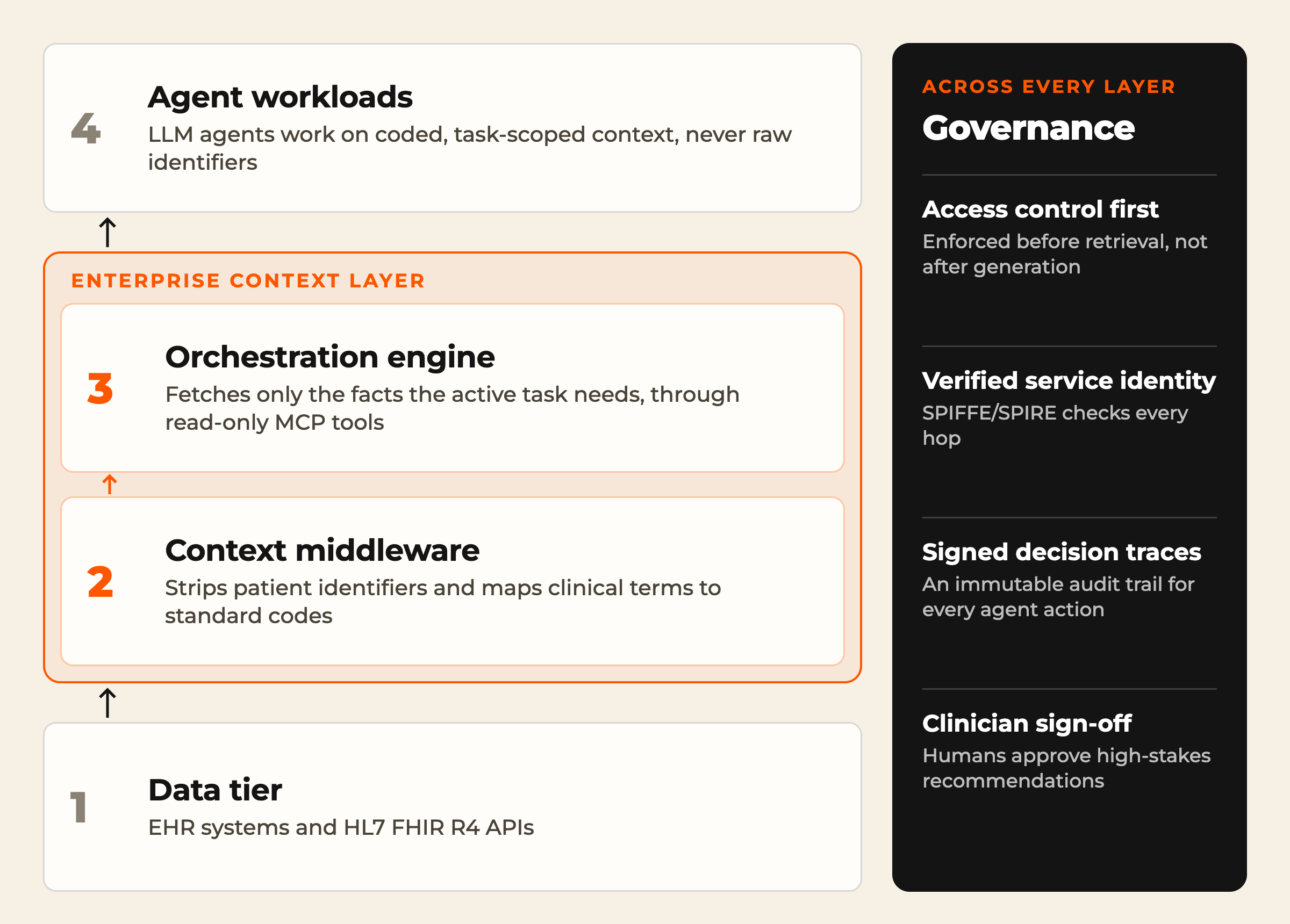
Traditional retrieval-augmented generation architectures fail HIPAA's strict Minimum Necessary standard by blindly stuffing raw patient charts into context windows. Every unfiltered token is a liability. A dedicated enterprise context layer architecture intercepts, sanitizes, and scopes clinical data before any prompt is constructed. This accelerates compliance while fueling agent accuracy.
1. The three PHI attack surfaces in agentic AI
1.1 Training data leakage & over-retrieval
Fine-tuning large language models on raw EHR data risks encoding PHI directly into model weights: a breach that no runtime guardrail can reverse. This leak is permanent. Worsening this risk, standard vector space retrieval grants agents access to far broader records than any single clinical task requires, violating healthcare compliance requirements at the retrieval layer itself. Think of it as a digital vault where AI can see the door but never touch the handle. Role-based access control must be enforced pre-retrieval, not post-generation, ensuring that LLM agents only ingest the minimum necessary data points required for the immediate clinical task, thereby preventing unauthorized exposure of sensitive patient records.
1.2 The vector database erasure problem
HIPAA's Right of Access and the "Right to be Forgotten" collide directly with vector embeddings. Deleting a specific patient's data from a dense vector store is technically non-trivial and often impossible without full index reconstruction. A non-custodial secure enterprise platform negates this risk entirely by operating statelessly. It never persists PHI into a secondary data lake, so there is nothing to erase and no surface to breach.
Output generation is the third attack surface. Without deterministic guardrails, a model can reconstruct PHI from contextual inference. This is a silent leak. The data isolation architecture enforces protected environment compliance by passing only structured, anonymized clinical codes to the agent, never raw identifiers, aligning with HHS Zero-Trust Architecture guidelines that mandate strict verification of every transaction within the clinical data pipeline.
2. The semantic backbone: Mapping UMLS, SNOMED CT, and RxNorm
2.1 Standardized terminology mapping at the edge
The context layer runs a local terminology server to perform healthcare knowledge graphing entirely within the enterprise perimeter, bypassing external APIs to keep all sensitive patient data strictly contained within your secure infrastructure. Unstructured EHR notes undergo precise medical terminology mapping and are resolved against a dynamic knowledge graph for clinical terms in sub-100ms, eliminating semantic ambiguity before the prompt is built. Speed prevents clinical delay.
- UMLS Integration: Normalizes clinical terms and maps cross-vocabulary equivalents.
- SNOMED CT Mapping: Represents clinical relationships, such as "caused by," as knowledge graph edges.
- RxNorm Standardization: Automates precise medication reconciliation.
- USCDI v3 Compliance: Programmatically supports mandatory USCDI v3 compliance 2026 data elements, including Social Determinants of Health.
This semantic grounding accelerates AI in healthcare compliance and drives LLM precision to 93.75%, establishing the clinical trust that enterprise deployments demand.
2.2 USCDI v3 compliance & interoperability
HL7 FHIR R4 APIs align data classes across systems while the context layer maps each element to its USCDI v3 equivalent ahead of the January 1, 2026, mandatory deadline, as outlined in USCDI v3 compliance 2026 technical specifications. Semantic interoperability is enforced at the middleware level, not delegated to the model. The model remains clean.
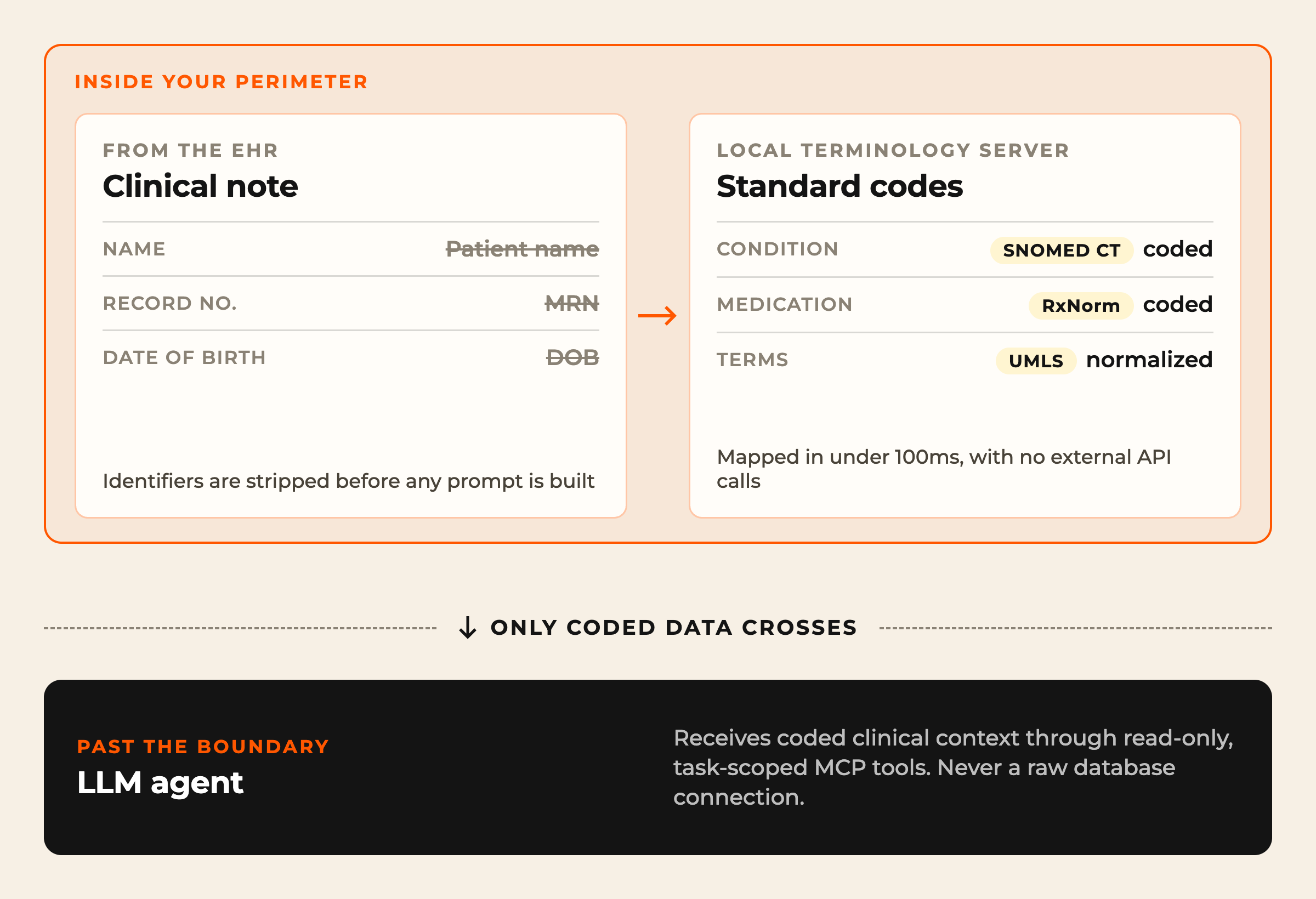
Row-level security and tenant-aware routing enforce logical isolation, preventing cross-tenant data contamination across multi-org deployments. Data boundaries are absolute. The medical context orchestration engine acts as an intelligent traffic controller that routes complex cases to the right specialists automatically. It enforces the minimum necessary standard AI mandate (see architectural guidelines) via the Model Context Protocol (MCP): exposing only read-only, task-scoped tools to each agent, never a raw database connection.
3. Implementing immutable decision traces and human-in-the-loop oversight
3.1 Zero-trust context orchestration
Dynamic, event-driven medical context orchestration retrieves only the clinical facts required for the active task at runtime. Only active data is fetched. SPIFFE/SPIRE service identity verification verifies every microservice hop, ensuring no agent escalates its own data access privileges or accesses unauthorized resources across the distributed enterprise network, maintaining a strict zero-trust posture.
3.2 Human-in-the-loop validation & auditing
Every agent action generates an immutable decision trace: a cryptographically signed audit trail that meets HIPAA Security Rule requirements and accelerates regulatory review. AI suggests; humans decide. Clinicians validate high-stakes recommendations before execution, embedding human-in-the-loop validation into the workflow loop. Routing triage through the context layer keeps your specialists on patient care, not administrative routing. This mirrors Ovidius AI's AI implementation methodology and the governance standards built into our enterprise AI solutions.
Clinical trust is built on mathematically enforceable infrastructure. A hipaa compliant ai context layer is not optional for enterprise healthcare AI: it is the only architecture that resolves the compliance paradox at scale while maintaining data isolation without capability loss.
Ready to secure your clinical AI pipeline? Partner with Ovidius AI as an extension of your team. We deliver a working solution in production: featuring an agentic, low-code AI workflow and a secure data isolation architecture, on a timeline we agree with you once the scope is clear. Schedule a Demo of our HIPAA-Compliant Context Layer today.
[1] JAMA Network: Administrative Savings in Healthcare. [2] HHS Guidelines: Minimum Necessary Standard (45 CFR § 164.502(b)). [3] JMIR AI 2025: Ontology Mapping Accuracy.