What Is AI Consulting? How It Moves AI From Pilot to Production

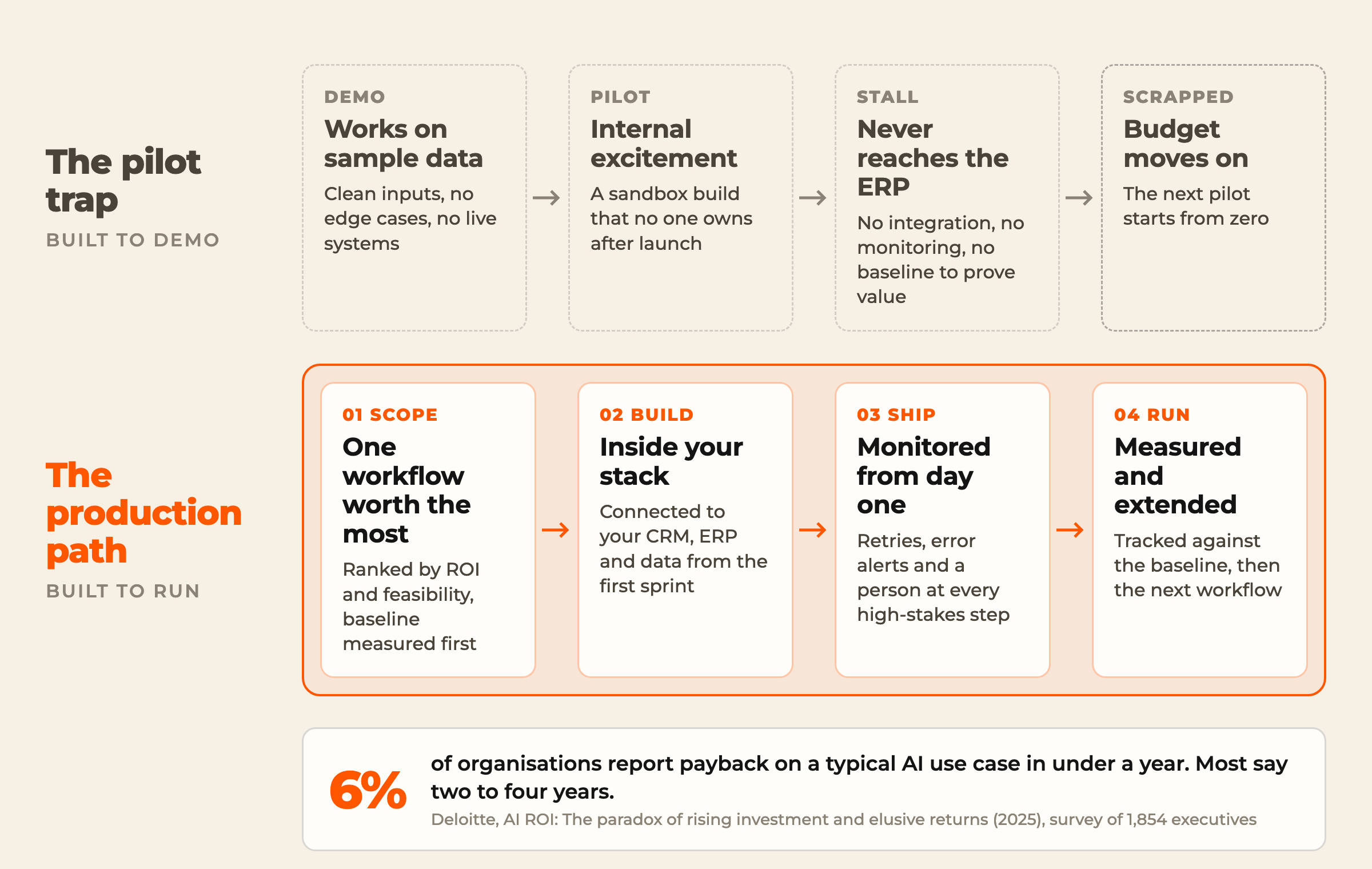
Deloitte's 2025 survey of 1,854 executives across Europe and the Middle East found that 85% of organisations increased their AI investment in the previous 12 months and 91% plan to increase it again. Most of those same organisations report satisfactory ROI on a typical AI use case only after two to four years, and just 6% see payback in under a year. If your own pilot impressed in a demo and then stalled before it reached daily operations, those numbers describe it.
In Harvard Business Review's March 2026 analysis of the "last mile" problem, the cause is how companies are organised, and model quality is rarely the obstacle. Pilots multiply, processes carry years of workarounds, and the knowledge needed to automate a task sits in the heads of the people who do it. AI consulting exists to close that last mile.
What Is AI Consulting?
AI consulting is the work of finding where AI will pay back in your operation, designing the system that does it, building that system into the tools your team already uses, and keeping it running. A useful engagement leaves you with a working workflow inside your ERP, CRM or support desk, measured against a baseline, and a team that knows how to own it. The strategy matters as far as it shapes that build.
Traditional firms often split the two: one team writes the roadmap, and a different team implements it months later. Engineering-led firms keep strategy and build with the same people, so the decisions made in the audit are the ones the code carries out. How we work lays out that sequence step by step.
Worker access to AI rose by 50% in 2025, yet only one in five companies has a mature governance model for autonomous AI agents.
Deloitte, State of AI in the Enterprise (2026), survey of 3,235 leaders
What Does an AI Consultant Do? From Strategy to Code
Map the opportunities and test feasibility
Before any code, the consultant maps your tech stack, data quality and day-to-day workflows, then ranks each candidate use case by financial return and technical feasibility at the same time. That ranking keeps budget away from pilots that demo well and fail on production data. It also exposes the integration points early: where the new system has to write into your ERP or CRM, and which team will need to change how it works. Our AI Audit produces this ranking as a fixed-fee engagement that ends in a 90-day roadmap.
Design the architecture and build it
An engineering-led consultant writes the code. That covers agentic workflows connected to your systems, model integrations that keep your data inside your own environment, and the orchestration that sends each decision to a person or to an automated step. Ovidius builds most of these on self-hosted n8n, with retries and error alerts in the first release. For larger estates, an enterprise context layer gives every agent the same governed view of company data. Where your developers are capable but stretched, the consultant works as an extension of that team, which is faster and lower-risk than hiring AI engineers from scratch.
Prepare your people
In Deloitte's 2026 report, leaders name insufficient worker skills as the biggest barrier to integrating AI into existing workflows. The most common response, used by 53% of organisations, is educating the broader workforce to raise AI fluency, and far fewer redesign roles, workflows and career paths around the new tools. Training teaches people the tool, and redesign changes who owns the exceptions. A consultant designs the human-in-the-loop steps and the training together, so the people who used to do the task become the ones who check its output and improve it. Our corporate AI training programs cover the training side.
Govern agents before they go live
Autonomous agents act on your systems, so their permissions, audit logs and escalation rules need to exist before the first one ships. Setting those up front is far cheaper than retrofitting them after an incident, and it is the gap the Deloitte figure above describes. Our enterprise AI governance work sets those rules alongside the build.
Why the consulting model itself is changing
HBR's September 2025 analysis of consulting firms describes a shift from the traditional pyramid, wide at the base with junior analysts, to a leaner "obelisk" with fewer layers and smaller teams, because AI now handles much of the research, modelling and analysis juniors used to do. For you as a client, more of the fee pays for senior engineers and the people who lead the work, and less pays for report production.
The Strategic Benefits of AI Consulting for Businesses
Faster time to value
The ROI gap between generative and agentic AI is worth knowing before you commit to either. In Deloitte's 2025 survey, 15% of organisations using generative AI report significant, measurable ROI, against 10% for agentic AI, which comes with more complexity and longer implementation timelines. A consultant shortens that curve by starting with the workflow that has the clearest ROI signal, such as lead routing, support triage or financial reporting, and measuring it against a baseline set before launch.
For GoKickflip, Ovidius built a multi-agent content pipeline on n8n in 30 days. Cost per article fell from $700 to $12, and output rose from 4 or 5 articles a month to 43, which works out to $358K a year saved at equal volume.
Compliance built into the workflow
In regulated industries a non-compliant output carries legal consequence, so validation belongs inside the workflow. A well-designed build checks generated output against your rules before anyone sees it, logs every decision, and keeps data in your own cloud where GDPR or sector rules require it. On our enterprise AI chatbot builds, a second agent checks each answer before it reaches a customer.
One team from strategy to execution
Splitting strategy and implementation across two firms is where many projects break down. The roadmap ages while the build waits, and the build team inherits decisions it did not make. When the same engineers run the audit, the build and the support, every architectural choice traces back to a business outcome you agreed on together. That is the model behind our AI consulting services.
The first workflows that usually pay back:
- Lead routing and CRM updates: new records scored, assigned and synced to the ERP without re-keying, built by our n8n agency team.
- Customer support triage: an AI chatbot that answers from your own data and hands the hard cases to a person.
- Content production: research-to-draft pipelines like the ones in our case studies.
- Knowledge retrieval: answers drawn from scattered documents and systems through a governed context layer.
- ERP actions from a conversation: purchase order approvals and invoice triage, as in our n8n and SAP Joule Studio guide.
Implementing AI Solutions for Enterprises: A 4-Step Framework
Step 1: The process audit and ROI mapping
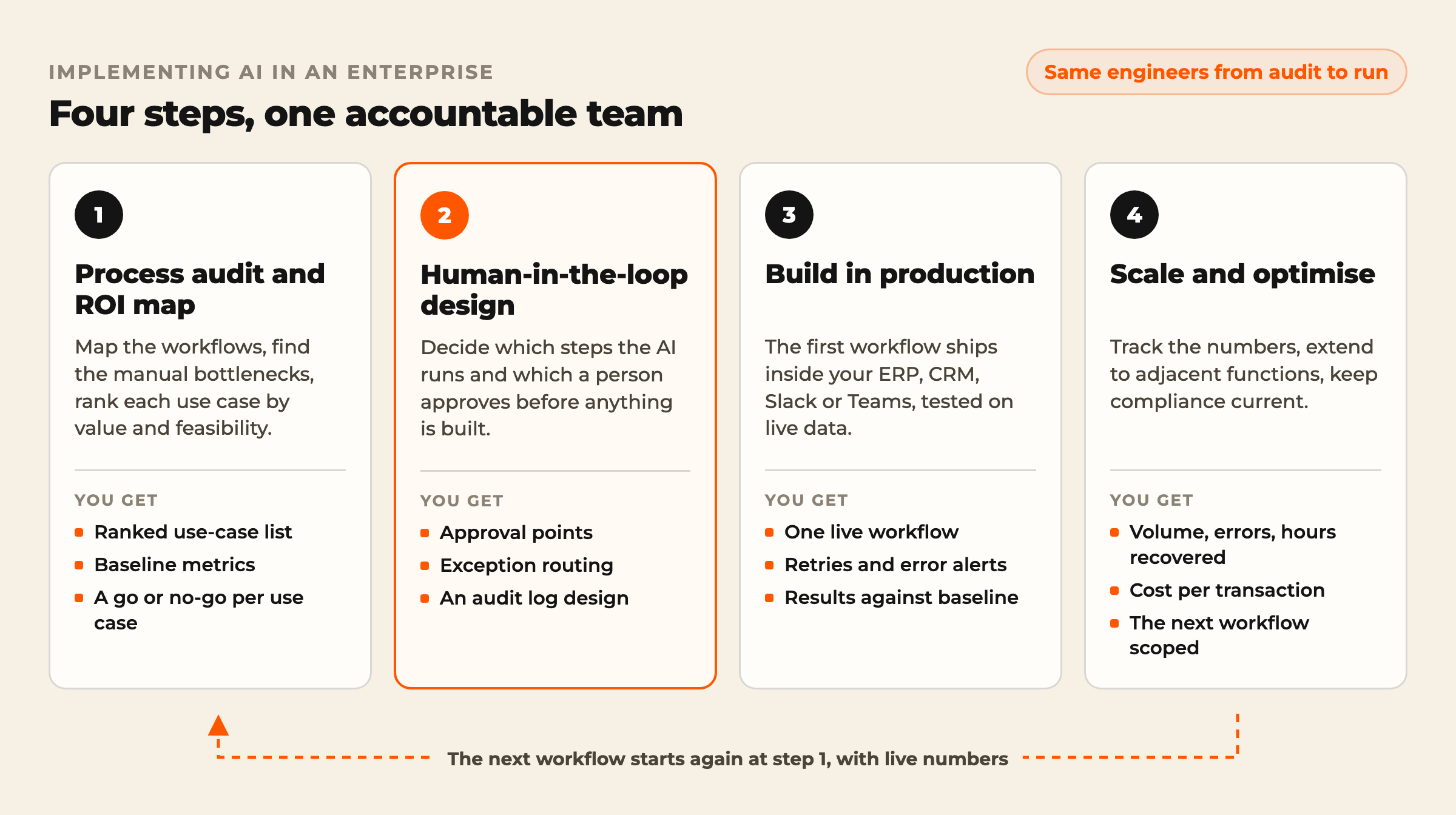
Map your existing workflows and find the manual bottlenecks that cost the most time. Rank use cases by technical feasibility and financial impact, and ignore novelty. Set each success metric with a measured baseline, such as hours of triage per week or the error rate on data entry, so the result can be proved later. Our AI readiness assessment and enterprise AI roadmap pages show what this step produces.
Step 2: Designing the human-in-the-loop architecture
Decide which steps the AI handles, such as routing, validating and flagging data, and which steps a person approves. High-stakes decisions keep a named owner, which is what compliance frameworks expect and what earns your team's trust in the system.
Step 3: Prototyping in production
Build the first workflow inside the tools your team already uses: the ERP, the CRM, Slack or Teams. Testing on live data at this stage validates the business case with real numbers and surfaces the edge cases a sandbox hides. How long it takes depends on the systems involved. GoKickflip's pipeline went from kickoff to production in 30 days, and the audit gives you an estimate for your own build before you commit. See our enterprise AI proof of concept approach for how the go or no-go decision is made.
Step 4: Scaling and continuous optimisation
Once the first workflow is stable, track execution volume, error rate, hours recovered and cost per transaction against the baseline. Extend the model to adjacent functions, update prompts and models as your data changes, and keep compliance current with regional rules. Move the capacity the automation frees up toward the work your people are best at. If you would rather not run the system yourself, AI managed services covers that phase.
Frequently Asked Questions About AI Consulting
What does an AI consultant do day to day?
An AI consultant maps your workflows, ranks use cases by return and feasibility, designs the system, and on an engineering-led team, builds and maintains it. Expect working sessions with the people who do the work today, integration with your existing systems, and a baseline that the result is measured against.
How much does AI consulting cost?
Cost depends on scope and on how many systems the build touches. Ovidius starts with a fixed-fee AI Audit, and the fee is credited toward your first deployment contract, so you see the execution plan and its projected return before committing to a full build.
How long does an AI consulting engagement take?
The audit runs in under 30 days. The build timeline depends on the workflow and the systems it connects to, which is why the audit ends with a 90-day roadmap and a build estimate. GoKickflip's content pipeline reached production in 30 days.
Should we hire an AI consultant or build an in-house team?
Hire in-house for capacity you will need for years. Bring in a consultant to ship the first production workflows, set up the architecture and monitoring, and train the people who will own it, so your hires inherit a working system. Meet the team that would run yours.
"From day one, the Ovidius team moved fast, thought big, and executed with precision. Together, we built something truly cutting-edge that will be a major unlock for our business and change how we operate and grow."
Renaud Teasdale, Founder and CEO, GoKickflip
Find out where AI pays back in your operation
In a 30-minute discovery call you speak directly with an AI engineer about the process you want to automate. If an audit is the right first step, we will tell you and scope it on the call.
Sources
- Deloitte (2025). AI ROI: The paradox of rising investment and elusive returns. Survey of 1,854 executives across Europe and the Middle East.
- Deloitte (2026). State of AI in the Enterprise. Survey of 3,235 leaders, August to September 2025.
- Harvard Business Review (March 2026). The Last-Mile Problem Slowing AI Transformation.
- Harvard Business Review (September 2025). AI Is Changing the Structure of Consulting Firms.
- Ovidius AI. GoKickflip case study.
Written by the Ovidius AI Editorial Team, the engineers and strategists who scope, build and run AI workflows for clients including GoKickflip and IES Limited.