Build vs Buy for Enterprise AI: A Pragmatic Decision Guide for Modern Leadership

Enterprise AI Strategy
Your board wants an AI strategy delivered yesterday. Your engineering team is quoting 18-month timelines. And the vendor demo you sat through last week showed a polished product that, on closer inspection, could not connect to your ERP without another six months of custom middleware work.
Every month spent in investigation is a month your competitors are automating. The capital at risk is real, and the pressure is acute. Enterprise leaders are not wrestling with a philosophical question about AI's potential; they are caught in a very concrete operational trap.
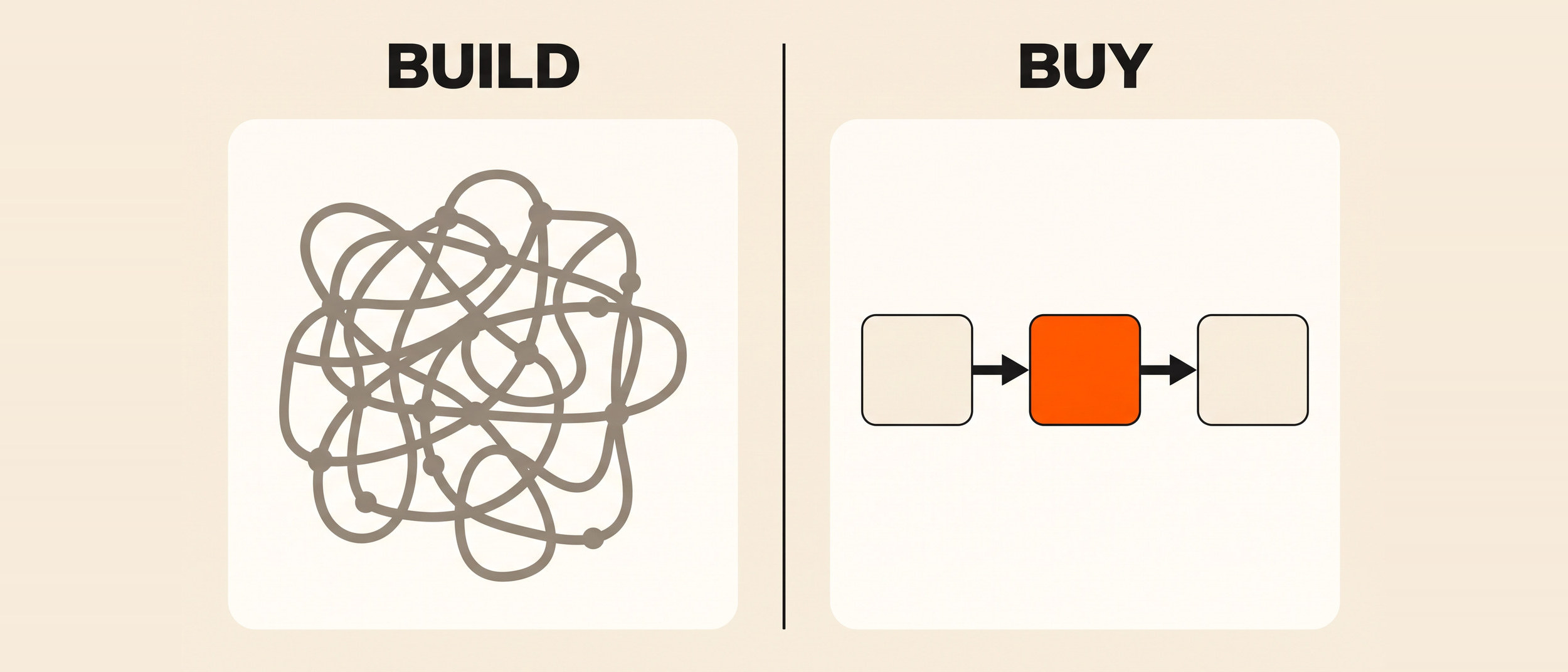
The build vs buy AI debate has been framed as a binary for too long. It is not. The productive question is not "which path?": it is "which layer?" You buy the orchestration infrastructure. You build the proprietary workflows that define your competitive edge. That sequencing distinction is where most enterprise AI strategies either gain traction or stall out entirely.
95% of enterprise AI pilots fail to deliver measurable business value or ROI, Harvard Business Review, "What Companies with Successful AI Pilots Do Differently"
That 95% failure rate is not a technology problem. Enterprises often treat AI like a legacy enterprise resource planning (ERP) deployment: they spend months on requirements gathering, hire armies of consultants, and write thousands of lines of custom code, only to arrive at launch day with a stale model and shifted data. The architecture they constructed was solving a problem that no longer exists in quite the same shape. Leadership must stop engineering the perfect system and start executing toward a production-ready workflow.
1. The Hidden Costs of the Binary Choice: Pure Build vs. Pure Buy
A pure internal build sounds strategically appealing: proprietary IP, absolute control, and no vendor dependency. But the talent acquisition strain alone derails most enterprise timelines before a single model reaches production. Senior machine learning engineers, data scientists, and ML infrastructure specialists command compensation packages that strain even well-funded technology budgets, and the market for this talent remains fiercely contested. Assembling the team is often the longest phase of the entire project.
Beyond headcount, custom AI models carry a continuous maintenance burden that most project plans underestimate. Model performance degrades as real-world data patterns shift, a phenomenon called data drift. Internal teams end up spending the majority of their capacity retraining models and patching pipelines rather than building the next high-value workflow. The build path does not just cost more upfront; it compounds.
The pure buy path carries its own compounding friction. Off-the-shelf enterprise software and generic SaaS applications promise fast time-to-value, but enterprises accumulate these tools at a pace that generates serious integration sprawl. When each new AI tool operates in its own silo, connecting them to your existing customer relationship management software or enterprise resource planning system requires brittle middleware that fractures whenever a vendor pushes an update.
SaaS pricing adds another layer of exposure. Per-seat licensing scales aggressively as your organization grows, and vendors retain full control over their roadmaps and pricing structures. You are renting your operational efficiency from a third party who can reprice or deprecate features at any point. That is not a risk profile most enterprise leaders would accept in any other category of critical infrastructure.
The productive reframe is this: draw a hard line between commodity infrastructure and competitive differentiation. Do not build your own large language models, database engines, or hosting layers: those are utilities. Build your AI teammate that handles the repetitive triage your team hates, focusing on the business logic and custom integrations that directly touch your customers or automate your core operational IP. That boundary is where your moat lives.
2. The Hybrid Framework: Buy the Orchestration, Build the Workflows
Modern enterprises are converging on a hybrid AI architecture, not as a compromise, but because it is structurally superior to either extreme. The execution path, however, remains murky for many leadership teams.
The process is direct. You adopt a highly capable platform to build automation that works with your existing tools without a massive IT overhaul; n8n is the most capable self-hosted option in this category, serving as your integration and automation layer. That is the buy decision. On top of that governed, secure foundation, you construct highly customized AI teammates that handle the repetitive triage your team hates, encoding your specific business logic. That is the build decision. Self-hosted deployment ensures your data never traverses a public SaaS API, which resolves the compliance exposure that kills so many AI initiatives in regulated industries. Development timelines compress substantially when your orchestration layer is already in place; building a new custom workflow becomes a configuration and logic problem, not a ground-up engineering undertaking.
Before committing to either path for any given use case, run it through four questions:
- Strategic Value: Does this workflow differentiate your business, or is it a back-office utility? Core differentiators warrant custom logic. Standard document parsing or routine data formatting does not.
- Data Sovereignty & Compliance: Does the use case process sensitive customer data? Self-hosted agentic pipelines keep that data inside your infrastructure, bypassing the compliance risks inherent in public SaaS APIs.
- Integration Complexity: Does the AI need to connect to legacy enterprise resource planning software or a proprietary customer relationship management system? Custom orchestration layers handle these integrations far more reliably than rigid out-of-the-box tools.
- Total Cost of Ownership: Model the 3-year cost honestly. A self-hosted custom workflow carries a flat operational cost. Commercial SaaS scales its pricing as you scale your team.
The objection that custom builds take too long is legitimate, but only when applied to traditional development practices. Modern agentic AI and low-code orchestration have rewritten those timelines. You do not need an 18-month timeline. By working with a specialized delivery team, you can bypass the bloated discovery phase entirely and deploy a working, production-ready solution in under 30 days.
Before any code gets written or any contract gets signed, enterprises need a rigorous process audit. Map your existing manual workflows and rank potential automation targets by financial return. That exercise ensures your investment lands on high-leverage operations, such as reducing manual triage time, eliminating repetitive data entry, and automating appointment scheduling, rather than on technically interesting but operationally marginal projects.
Custom agentic workflows also generate an asset class most enterprises overlook. When you build proprietary automation logic, you are not just reducing operational costs; you are constructing technology that can be packaged, white-labeled, and sold to your own clients. An internal efficiency project becomes a recurring revenue stream, which is a fundamentally different return profile than a SaaS subscription.
3. How Ovidius AI Delivers the Best of Both Worlds in 30 Days
You do not have to choose between the inflexibility of generic SaaS and the agonizingly slow timelines of traditional custom development. Ovidius AI acts as an extension of your team, delivering production-ready, custom AI workflows within 4 weeks of kickoff.
As a Certified n8n Select Partner, Ovidius AI specializes in building highly secure, self-hosted agentic AI pipelines that preserve absolute data sovereignty while automating your most repetitive manual tasks. No vague promises. No endless discovery phases. Working solutions that drive a clear return on investment from week five onward.
Ready to stop debating and start executing? Book a complimentary AI Audit with Ovidius AI today. We will map your current technology stack, identify your highest-leverage automation targets, and rank your AI use cases by financial ROI. Let's build your production-ready workflow in under 30 days.
Footnotes
1 Harvard Business Review, "What Companies with Successful AI Pilots Do Differently" (September 2025). HBR Article