n8n + SAP Joule Studio: Integration Guide


This guide covers three things enterprise architects need to evaluate before committing to this integration:
- Architectural Paradigm Shift: How connecting conversational AI (SAP Joule Studio) with visual background execution (n8n) via the Model Context Protocol (MCP) solves the "last-mile" execution gap, the point where AI intent stalls and nothing runs.
- Enterprise-Grade Governance: Maintaining strict data residency, security compliance, and centralized API management within the SAP Business Technology Platform (BTP) without sacrificing the agility that makes low-code automation worth pursuing.
- Practical Operational ROI: Transforming user intent into background logic through real-world use cases like automated purchase order routing and unmatched invoice triage, workflows that eliminate manual overhead at scale.
SAP Joule is persuasive. Enterprise leaders deploy it, users engage with it, and the conversational interface genuinely impresses in demos. Then someone asks it to "reconcile outstanding accounts" or "route pending purchase orders for approval," and the conversation ends where the work should begin. Joule can understand the request. It cannot reliably execute the multi-step, cross-system logic that request demands, not without a deterministic execution layer behind it.
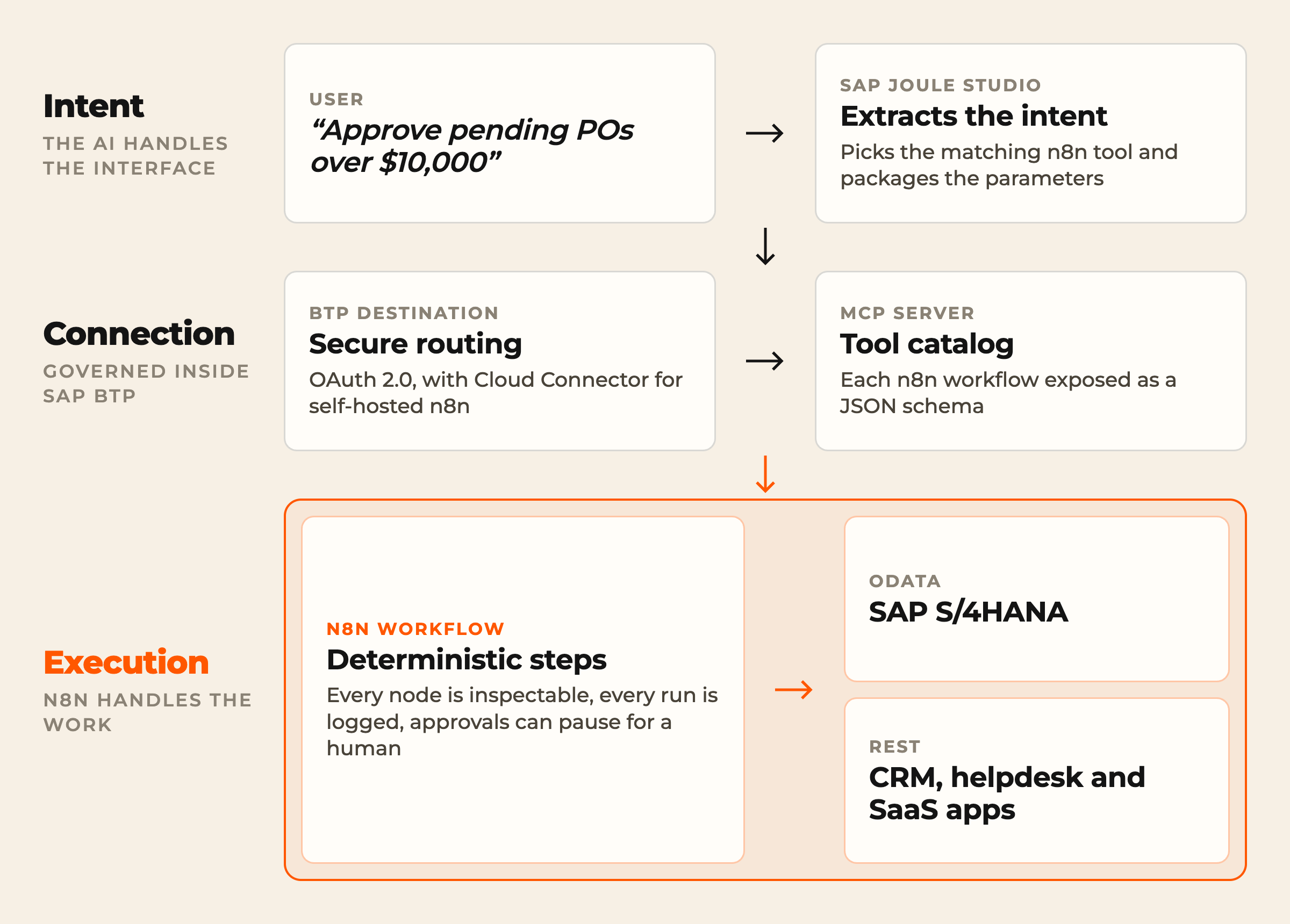
The n8n SAP integration solves exactly this gap. By connecting Joule Studio's conversational frontend to n8n's visual workflow canvas via the Model Context Protocol, enterprises get a system where natural language intent triggers governed, auditable, step-by-step background execution. The AI handles the interface. n8n handles the work.
By embedding n8n's visual canvas within the SAP ecosystem, organizations bypass the custom middleware development that traditionally turns integration projects into year-long ordeals. An n8n AI agent can interact directly with enterprise resource planning SAP modules, orchestrating data flows across both SAP and third-party SaaS applications. This architectural shift enables fusion teams, developers and business analysts working in parallel, to build, test, and deploy integrations in weeks rather than months, compressing delivery timelines while maintaining the IT control that core ERP systems demand. Ovidius builds these integrations as an enterprise n8n agency.
The Architectural Paradigm Shift: How n8n Integrates with SAP Joule Studio
Understanding the Model Context Protocol (MCP)
The Model Context Protocol is an open standard that profoundly changes how large language models interact with backend tooling. Rather than requiring developers to hard-code a specific API call for every possible user action, MCP allows SAP Joule Studio's LLM to dynamically discover available tools at runtime and select the appropriate one based on the user's expressed intent. Each n8n workflow is exposed as a structured, callable tool, complete with a JSON schema describing its inputs, outputs, and purpose.
What this eliminates is substantial. Traditional integration approaches require a custom middleware layer for every Joule-to-backend interaction: bespoke endpoints, versioned contracts, and a growing surface area of brittle glue code. MCP replaces that with a standardized discovery mechanism. Joule queries the MCP server, receives a catalog of available n8n workflows, and calls the right one with the correct business context already packaged. The protocol passes not just raw parameters but the structured data model Joule extracted from the conversation, vendor IDs, order numbers, approval thresholds, directly into n8n's execution engine.
This is where the ecosystem alignment becomes architecturally meaningful. Agile AI agents and core enterprise infrastructure have historically operated on incompatible timescales: AI moves fast, ERP systems move deliberately. MCP creates a stable interface between them, allowing each side to evolve independently without breaking the connection.
Transitioning from Conversational Intent to Visual Canvas
Joule's natural language interface is genuinely good at intent extraction. It understands context, tolerates ambiguity, and can resolve "approve the big orders from last week" into a structured query. What it cannot do reliably is guarantee the sequence of operations that follows: fetch records, evaluate conditional logic, route to the correct approver, update the ERP, log the transaction. LLMs are probabilistic; ERP operations require determinism.
The visual workflow canvas in n8n is where that determinism lives. Each node in the canvas represents a discrete, inspectable step. Developers can see exactly what data enters a node, what transformation or API call occurs, and what exits. When something breaks, the execution log shows precisely where and why, a debugging experience that is categorically different from tracing failures through a black-box AI response.
Human-in-the-loop steps are simple to embed. An approval node can pause execution, dispatch a Slack or Teams message to the designated approver, and wait for a response before proceeding. As a first-class design pattern in n8n, this approach makes the integration safe for high-stakes business logic. The visual canvas also makes it practical for non-engineers to understand what a workflow does, which matters when business stakeholders need to validate that automation logic matches their intent.
To achieve true operational efficiency, an enterprise cannot rely on autonomous AI agents acting without guardrails. The n8n SAP Joule Studio connection establishes a hybrid model: Joule handles the conversational interface and understands user intent, while n8n executes the deterministic logic. When a user asks Joule to "reconcile outstanding accounts," a knowledge graph provides the necessary business context, but the actual data transfer and ledger updates execute step-by-step within n8n's visual canvas, ensuring full accuracy and a complete audit trail.
The technical mechanism runs through a lightweight MCP server deployed within your cloud infrastructure. This server acts as a secure translator, exposing your n8n automation workflows as formatted JSON schemas that Joule can interpret and invoke. Because n8n natively supports MCP, configuring this connection requires no custom coding, only destination routing within the SAP Business Technology Platform. For enterprise IT teams accustomed to multi-month integration projects, that reduction in setup complexity is worth pausing on.
Key Capabilities of n8n SAP Integration
Bidirectional Data Synchronization
The integration enables authentic two-way data flows between SAP ERP and external platforms, CRM systems, databases, helpdesk tools, or any service exposing a REST or OData API. When a new customer record is created in SAP S/4HANA, an event-driven trigger in n8n fires immediately, propagating that record to downstream systems without manual intervention or scheduled batch jobs. The reverse path works equally well: an update in Salesforce or HubSpot can trigger a workflow that writes back to the relevant SAP module, keeping both systems current.
This matters because data fragmentation is where enterprise automation initiatives quietly fail. A workflow that automates a process but leaves data out of sync across departments doesn't eliminate manual work, it just relocates it. n8n SAP API connectivity, configured through authenticated BTP destinations, ensures that synchronization happens at the speed of the triggering event, not at the speed of a nightly import job. The result is a single source of truth that stays true. Data silos disappear.
Pre-built SAP Nodes and Custom Agent Orchestration
n8n ships with pre-built integration nodes that reduce the configuration overhead of connecting to SAP services. Rather than constructing raw HTTP requests and parsing OData responses manually, developers configure a node, authenticate it once, and reuse it across workflows. That reusability compounds quickly: a team building its fifth SAP workflow moves significantly faster than it did on the first. Development speed accelerates.
Beyond the native nodes, n8n's advanced AI agent nodes allow developers to embed language model reasoning directly inside a workflow. An agent node can receive an unstructured input, a PDF invoice, an email thread, a scanned shipping receipt, analyze it, extract structured fields, and pass those fields to downstream SAP API nodes. This is the architecture that makes invoice triage and document-heavy procurement workflows genuinely automatable rather than just partially assisted. n8n templates for common integration patterns further compress initial deployment time, giving teams a working scaffold to modify rather than a blank canvas to fill.
- Bidirectional Data Synchronization: Keep your CRM, ERP, and external databases aligned in real-time without manual data entry or batch reconciliation.
- Pre-built SAP Integration Nodes: Reduce API configuration overhead and accelerate deployment using n8n's native connector library.
- Custom AI Agent Orchestration: Build advanced, agentic workflows that handle unstructured data and complex decision-making with human-in-the-loop guardrails.
Step-by-Step Configuration: Connecting Joule Studio to n8n via BTP
Configuring SAP BTP Destinations
The SAP Business Technology Platform Cockpit is where the connection between Joule Studio and your n8n instance begins. Navigate to your BTP subaccount, open the Connectivity section, and create a new Destination entry pointing to the hostname and port of your n8n deployment. The destination type should be HTTP, and the authentication method should be configured to match your security posture: OAuth 2.0 client credentials is the recommended approach for production environments, though secure API key authentication is feasible for controlled staging setups.
Network routing requires attention when n8n runs in a self-hosted environment outside SAP's managed infrastructure. BTP's Cloud Connector bridges that gap, establishing an encrypted tunnel between the BTP subaccount and your private network without requiring inbound firewall rules. Once the Cloud Connector is configured and the destination is saved, use BTP's built-in connection test to verify end-to-end reachability before proceeding. A failed test at this stage is far easier to diagnose than a failed execution mid-workflow. Test early and often.
Enabling the n8n MCP Server and Defining Tool Schemas
Within your n8n instance, enabling MCP server functionality exposes your workflows as discoverable tools. Each workflow intended for Joule invocation needs a corresponding JSON schema that defines its name, description, and parameter structure. The description field carries distinct weight, Joule's LLM uses it to decide whether a given tool matches the user's intent, so a vague description produces unreliable tool selection. Write descriptions that specify the business action, the required inputs, and the expected outcome in plain, precise language. Clarity prevents execution errors.
Webhook nodes serve as the entry points for incoming execution requests. Configure each webhook with a unique path, set the authentication method to match what your BTP destination sends, and map the incoming JSON payload to the workflow's input parameters. Once the webhook is live, test the full end-to-end path by issuing a natural language prompt in Joule Studio, something specific enough to unambiguously target one tool, and confirm the execution appears in n8n's workflow logs with the correct input data. Iterating on the JSON schema based on what Joule sends is normal at this stage; expect one or two refinement cycles before the mapping is clean.
- Configure BTP Destinations: Establish a secure, authenticated connection tunnel within the SAP BTP Cockpit pointing to your n8n instance.
- Enable the n8n MCP Server: Expose your visual workflows as callable, discoverable tools for SAP Joule Studio.
- Define Tool Schemas: Write precise JSON schemas for inputs and outputs so Joule's LLM understands when and how to trigger each workflow.
- Test the Conversational Trigger: Prompt Joule to execute a background task and monitor the real-time execution logs within the n8n canvas.
Ready to accelerate your proof-of-concept? At Ovidius AI, we act as a true extension of your engineering team, specializing in migrating complex routing and automating enterprise workflows in self-hosted n8n in weeks, not years. Schedule an architectural consultation to scope your first custom workflow.
Enterprise Governance, Security, and Compliance Guardrails
Maintaining Data Residency and Compliance
Self-hosting n8n within your own cloud boundary, AWS, GCP, Azure, or on-premises, means that workflow executions, API credentials, and all data in transit stay entirely within your governed infrastructure. No execution payload touches a third-party SaaS vendor's servers. Data remains secure. For organizations operating under strict US corporate governance frameworks or European GDPR requirements, this deployment model is not just advantageous; it's often the only architecture that satisfies the legal team.
Role-Based Access Control within n8n Enterprise restricts who can view, modify, or deploy workflows. Combined with single sign-on integration against your existing identity provider, this ensures that the same access governance policies applied to your SAP environment extend to the automation layer. Execution logs capture every workflow run, inputs, outputs, timestamps, triggering user, creating an audit trail that compliance teams can query without needing to involve engineering. That auditability is what transforms n8n from a developer tool into an enterprise-grade component.
The Role of SAP Integration Suite as the Governance Layer
n8n's agility is an asset, but without a governance boundary it becomes a vulnerability. Routing all n8n API calls through the SAP Integration Suite keeps every integration visible, rate-limited, and auditable from a single control plane. Security teams can inspect traffic, enforce policies, and revoke access without touching the n8n instance itself. This is the architectural pattern that prevents automation sprawl, the proliferation of unmanaged, shadow-IT workflows that individually seem harmless but collectively introduce compliance exposure.
The boundary between n8n and SAP's core systems deserves explicit definition. n8n handles agile, event-driven orchestration: routing, transformation, notification, and conditional logic. SAP's core ERP modules handle the authoritative record. This preserves data integrity. Data flows between them through authenticated, monitored API calls, including proprietary SAP-to-SAP protocols where applicable, never through direct database access or unmonitored endpoints. Keeping that boundary clean is what allows IT leaders to grant development teams the speed they need without ceding control of system stability.
Enterprise-grade security is non-negotiable when connecting low-code tools to core ERP systems. By deploying n8n in a self-hosted environment, organizations maintain absolute control over their data flows, ensuring that sensitive financial or customer data never leaves their secure cloud boundary. This is why leading enterprises partner with Ovidius AI to architect their automation layers.
This hybrid governance model allows IT leaders to say yes to business requests for rapid automation. By routing n8n's connections through the SAP Integration Suite, security teams can monitor, rate-limit, and audit every transaction. The agility of n8n workflow automation for SAP does not introduce operational risk to core ERP systems, operating within a defined, observable perimeter that preserves both developer velocity and enterprise compliance.
Practical Use Cases: Transforming Intent into Background Execution
Automated Purchase Order Routing and Approval
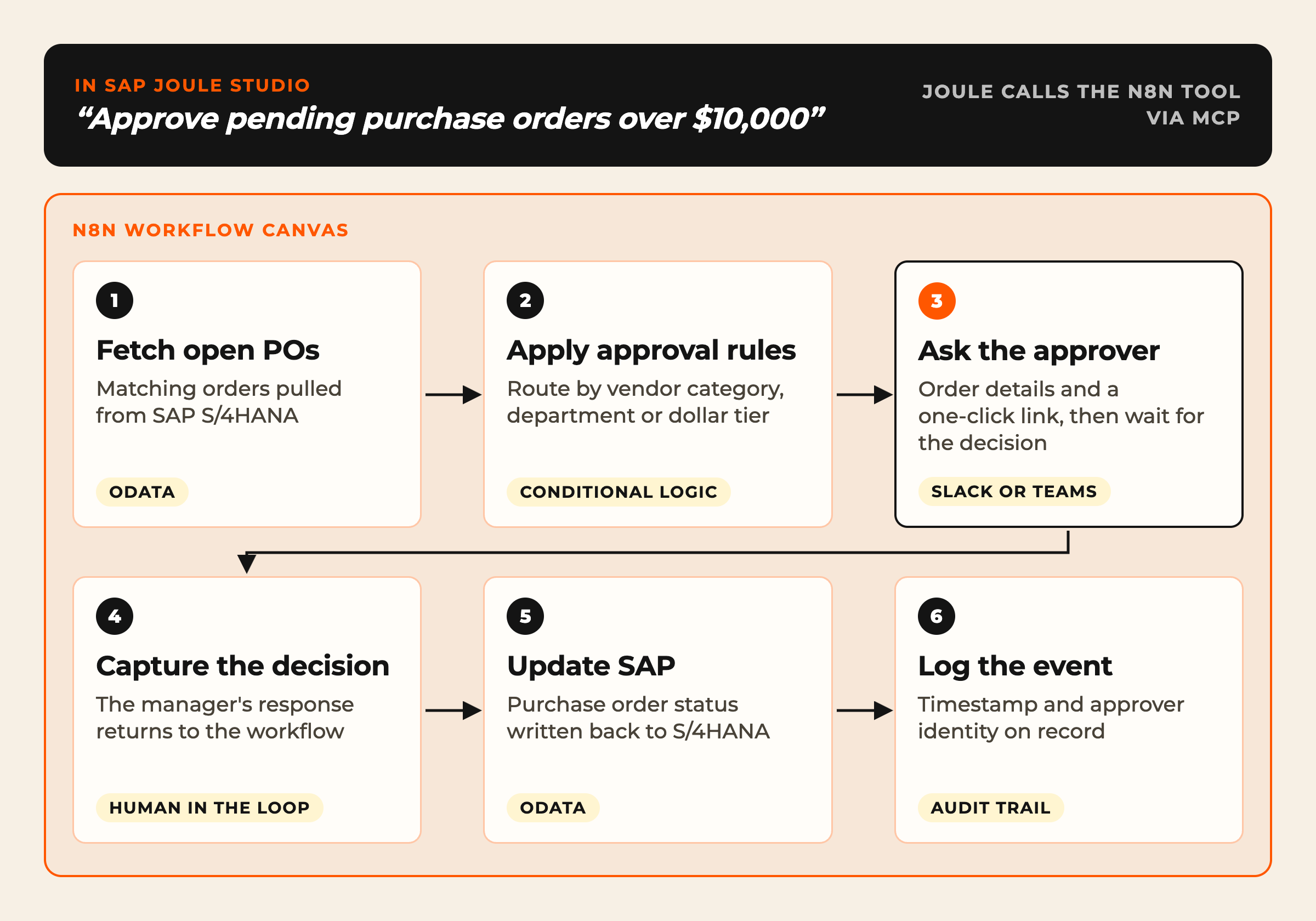
A user opens Joule Studio and types: "Approve pending purchase orders over $10,000." Joule identifies the intent, selects the corresponding n8n workflow tool via MCP, and passes the threshold value as a structured parameter. The workflow fetches the matching open purchase orders from SAP S/4HANA through an authenticated OData call, then evaluates each record against the organization's approval hierarchy, a conditional logic node that routes based on vendor category, department, or dollar tier.
Once the routing decision is made, n8n dispatches an approval request directly to the designated manager via Slack or Microsoft Teams, including the order details and a one-click approval link. When the manager responds, the workflow captures the decision, updates the purchase order status in SAP S/4HANA, and logs the approval event with a timestamp and approver identity. The email chain that used to carry this process, with its forwarding delays, missed replies, and manual ERP updates, is gone. The cycle time compresses from days to minutes, and every step is traceable. Efficiency increases immediately.
Unmatched Invoice Alerts and Automated Triage
Scheduled background execution is where n8n's value extends beyond conversational triggers. A workflow running on a defined schedule queries SAP for invoices that lack a matching purchase order or goods receipt. When inconsistencies surface, an embedded AI agent node analyzes each unmatched invoice against the available purchase order data and shipping receipts, classifying the discrepancy type and identifying the most likely resolution path.
Rather than dumping a raw exception list into a finance team inbox, n8n generates a structured triage alert: the invoice details, the nature of the mismatch, the suggested resolution, and a direct link for the finance team member to approve or override the draft resolution. What was previously a manual audit process, where staff pull reports, cross-reference documents, and compose emails, becomes an exception-only review task. The finance team sees only the cases that genuinely require human judgment, not every discrepancy the system can already settle. Human effort is optimized.
These use cases demonstrate that automating SAP workflows with n8n is not a theoretical exercise: it delivers measurable operational ROI by replacing manual data entry and email-based approvals with automated, event-driven flows. This is the exact type of high-impact execution that Ovidius AI specializes in. Our experience building custom AI-powered layers on top of complex ERP systems, including Odoo and SAP, ensures that your automation initiatives deliver working solutions, not architecture diagrams that sit in a shared drive.
We did in weeks what internal teams couldn't build natively in ERPs for a full year. Ovidius AI architects AI-powered n8n layers on top of your ERP to automate complex scheduling, routing, and approvals. We find your highest-ROI use cases and ship the first working solution in weeks, not quarters. Partner with Ovidius AI to accelerate your enterprise automation journey today.
Overcoming Common Integration Challenges
Managing Legacy Data Silos and Complex Schemas
SAP data models are not simple. Nested BAPIs, deeply hierarchical OData entities, and decades of custom fields accumulated through implementation projects create a mapping challenge that breaks naive integration approaches. The visual data mapping interface in n8n makes this manageable: developers can inspect the raw API response, drag fields into the transformation layer, and apply JavaScript or Python code nodes for the cases where visual mapping isn't expressive enough.
Defining clean, reusable data schemas within n8n, rather than handling transformation ad hoc in each workflow, pays compounding dividends. A standardized schema for a purchase order object, defined once and referenced across multiple workflows, means that when SAP's data structure changes, there's one place to update rather than ten. This approach replaces thousands of lines of custom integration code with a maintainable, inspectable visual layer that a developer joining the team six months later can understand.
Handling API Rate Limits and High-Volume Transactions
SAP APIs have rate limits, and high-volume transaction periods, such as month-end close, procurement cycles, or large batch imports, can push against those limits in ways that cause cascading failures. n8n's built-in retry logic and execution throttling settings address this directly. Configuring exponential backoff on API nodes ensures that temporary failures retry gracefully rather than propagating errors downstream. This prevents cascading failures.
For genuinely high-volume deployments, running self-hosted n8n in queue mode with Redis and multiple worker instances allows horizontal scaling. Execution requests queue rather than drop, workers process them at a controlled rate, and the core SAP APIs receive a steady, predictable load rather than traffic spikes. Automated alerting, such as a Slack or email notification triggered when a workflow's error rate exceeds a defined threshold, gives the engineering team visibility into production issues before they become incidents. There's no clean answer to every rate-limit scenario, but n8n's queue architecture handles the majority of enterprise-scale patterns without requiring custom infrastructure work.
- Legacy Data Silos: Overcome complex schemas by utilizing n8n's flexible data transformation nodes and visual mapping interface.
- API Rate Limits: Prevent system overloads by implementing native retry logic and execution throttling directly within n8n workflow settings.
- Complex BTP Routing: Simplify connectivity by establishing clear destination rules and standardized MCP tool definitions in the BTP Cockpit.
The Strategic Advantage of Low-Code Orchestration
Accelerating Time-to-Market for AI Initiatives
The gap between "we have an AI strategy" and "AI is running in production" is where most enterprise initiatives stall. Custom middleware development, lengthy vendor procurement cycles, and integration projects that expand in scope as they progress are the usual factors. n8n's low-code visual environment compresses that gap by allowing IT teams to prototype and test integrations in hours rather than weeks. A workflow that would take a backend developer several sprints to build as custom code can be assembled, tested, and iterated on in a single afternoon.
This speed doesn't come at the cost of flexibility. Control remains with IT. Because n8n is open-source and self-hostable, enterprises avoid the vendor lock-in that afflicts managed iPaaS platforms. The workflow definitions are portable JSON: exportable, version-controlled, and deployable across environments without platform dependency. As business requirements evolve, workflows can be modified through the visual canvas without touching the underlying infrastructure. That iterative capability is what allows AI initiatives to stay current with organizational needs rather than becoming legacy systems within two years of deployment.
Empowering Fusion Teams of Developers and Business Analysts
The visual canvas serves a function beyond execution: it's a communication medium. When a business analyst can open a workflow and trace the logic, where one node fetches data, another applies the business rule, and a third sends the notification, the conversation between business and IT changes. Analysts can identify where a rule is wrong without needing to read code. Developers spend less time translating requirements and more time building. Collaboration improves productivity.
IT maintains ultimate control over credentials, deployment environments, and security configurations. Business teams gain the ability to understand and contribute to workflow design without gaining the ability to break production systems. This division of responsibility reduces IT bottlenecks without creating ungoverned automation sprawl, the exact balance that makes digital transformation initiatives sustainable rather than chaotic. Organizations that establish this collaborative model consistently find that their automation plans accelerate, because the people who understand the business processes are actively involved in designing the workflows that serve them.
The strategic choice for modern enterprise IT is no longer between speed and security. By integrating n8n with SAP Joule Studio, organizations achieve both. Developers can build and iterate on complex n8n automation workflows at startup velocity, while IT leaders maintain strict control over data access, compliance, and system stability. This hybrid approach ensures that AI initiatives deliver tangible business value without introducing security risks that erode the trust that makes further investment possible.
Why Partner with Ovidius AI for Your SAP Automation Journey
Deep Expertise in n8n and Enterprise Integrations
Ovidius AI operates as a committed extension of your engineering team, with a specific focus on complex, self-hosted n8n deployments in enterprise environments. Ovidius is an official n8n Select Partner. The team has migrated CRM routing systems, automated lead triage pipelines, and built custom ERP automation layers, not in quarters, but in weeks. That delivery speed isn't a marketing claim; it's the operational model.
The Odoo implementation experience is revealing here. As the leadership of a Dutch Odoo Implementation Partner put it: "Ovidius did in weeks what we couldn't build natively in Odoo for a full year. They architected an AI-powered n8n layer on top of our ERP that now schedules well over a thousand appointments a week automatically. They are our preferred AI delivery partner." The same architectural approach, with an n8n orchestration layer sitting above the ERP to handle scheduling, routing, and conditional logic, applies directly to SAP environments. Ovidius AI's commitment is to identify your highest-ROI use cases first and ship a working solution against them, on a timeline agreed once the scope is clear.
End-to-End Execution and Strategic Governance
The engagement covers the full integration lifecycle. That means an initial audit to identify where automation delivers the clearest return, a deployment schedule that sequences implementations by impact, production deployment with security and compliance guardrails built in from the start, and ongoing maintenance as your workflows evolve. Governance isn't an afterthought: it's designed into the architecture before the first workflow is built, preventing the automation sprawl that undermines enterprise IT credibility.
Owen (CEO), Jason (COO), Ben (CMO), Oskar (CRO), and Maciej (CTO) are directly accessible throughout the engagement. This isn't a firm where a senior architect scopes the project and a junior team delivers it; the people who design your architecture are the people who build it. For enterprises making a significant investment in SAP and AI infrastructure, that consistency matters.
At Ovidius AI, we deploy working, production-grade AI and automation solutions, not generic consulting frameworks or slide decks that require another engagement to execute. We treat your business like our own, ensuring that every workflow we build delivers a clear return on investment and reduces operational costs. Whether you are looking to connect SAP Joule Studio to n8n, automate complex ERP routing, or deploy custom AI agents across your enterprise stack, our team is ready to build.
Frequently Asked Questions About n8n SAP Integration
Is n8n free to use within an SAP enterprise environment?
n8n offers a self-hosted community edition that is free to run, but enterprise deployments connecting to core systems like SAP generally require an n8n Enterprise license. That license unlocks the features that matter most in a governed SAP environment: advanced Role-Based Access Control, single sign-on integration, detailed audit logging, and official enterprise support. Running the community edition in a production SAP context means accepting meaningful gaps in access governance and compliance tooling, gaps that are difficult to justify when the integration touches financial or procurement data.
How does the Model Context Protocol (MCP) differ from traditional REST API integrations?
Traditional REST integrations require developers to write custom, hard-coded API endpoints and middleware for every interaction between Joule and a backend system. Each new capability means a new endpoint, a new contract, and a new maintenance burden. This overhead slows development. The Model Context Protocol replaces that pattern with dynamic tool discovery: Joule queries the MCP server, receives a catalog of available n8n workflows with their schemas, and selects the appropriate tool based on the user's natural language intent. The middleware layer disappears, integration complexity drops significantly, and adding a new capability means publishing a new workflow schema rather than deploying new API infrastructure.
Can we self-host n8n while connecting it to SAP Joule Studio?
Yes, and for most enterprise deployments it's the recommended approach. Self-hosting n8n on AWS, GCP, or Azure, or on-premises, keeps all workflow executions, API credentials, and data payloads within your governed network boundary. SAP BTP's Cloud Connector handles the secure tunnel between the BTP subaccount and your private infrastructure without requiring inbound firewall rules. Security is maintained. This deployment model satisfies strict corporate security policies and data residency requirements in a way that managed SaaS n8n instances cannot.
What SAP modules can be automated using n8n workflows?
n8n can integrate with any SAP module that exposes standard OData, REST, or SOAP APIs. In practice, this covers SAP S/4HANA for finance, procurement, and inventory management; SAP SuccessFactors for HR and employee onboarding; and SAP Ariba for supplier management and procurement workflows. Any module accessible through the SAP BTP API catalog is a candidate for n8n automation, which means the integration surface area spans the full enterprise tech stack rather than a narrow set of supported connectors.
How does the integration handle high-volume enterprise transactions?
Self-hosted n8n supports queue mode, which uses Redis and multiple worker instances to process executions asynchronously at scale. Rather than processing requests synchronously and risking timeouts or API overloads during peak periods, queue mode buffers executions and distributes them across workers at a controlled rate. Combined with per-node retry logic and execution throttling settings, this architecture allows n8n to handle millions of daily executions without overloading core SAP APIs. Automated alerting on workflow error rates provides early warning when volume patterns shift unexpectedly.
The integration of n8n and SAP Joule Studio closes the gap between conversational AI and deterministic execution, the gap where most enterprise AI initiatives currently stall. By utilizing the Model Context Protocol alongside n8n's visual canvas, organizations can deploy secure, governed, and highly automated workflows that translate user intent into immediate backend action across their entire SAP ecosystem. The architecture is proven, the tooling is mature, and the governance model is compatible with the compliance requirements that enterprise IT teams operate under.
What separates organizations that capture this value quickly from those that spend another year in planning is the implementation partner they choose. Ovidius AI's team, Owen, Jason, Ben, Oskar, and Maciej, is ready to design, deploy, and govern your custom AI-powered automation layer. Schedule your architectural consultation today and move from intent to execution.