What AI Consulting Costs: Hourly Rates, Projects, and Retainers Explained

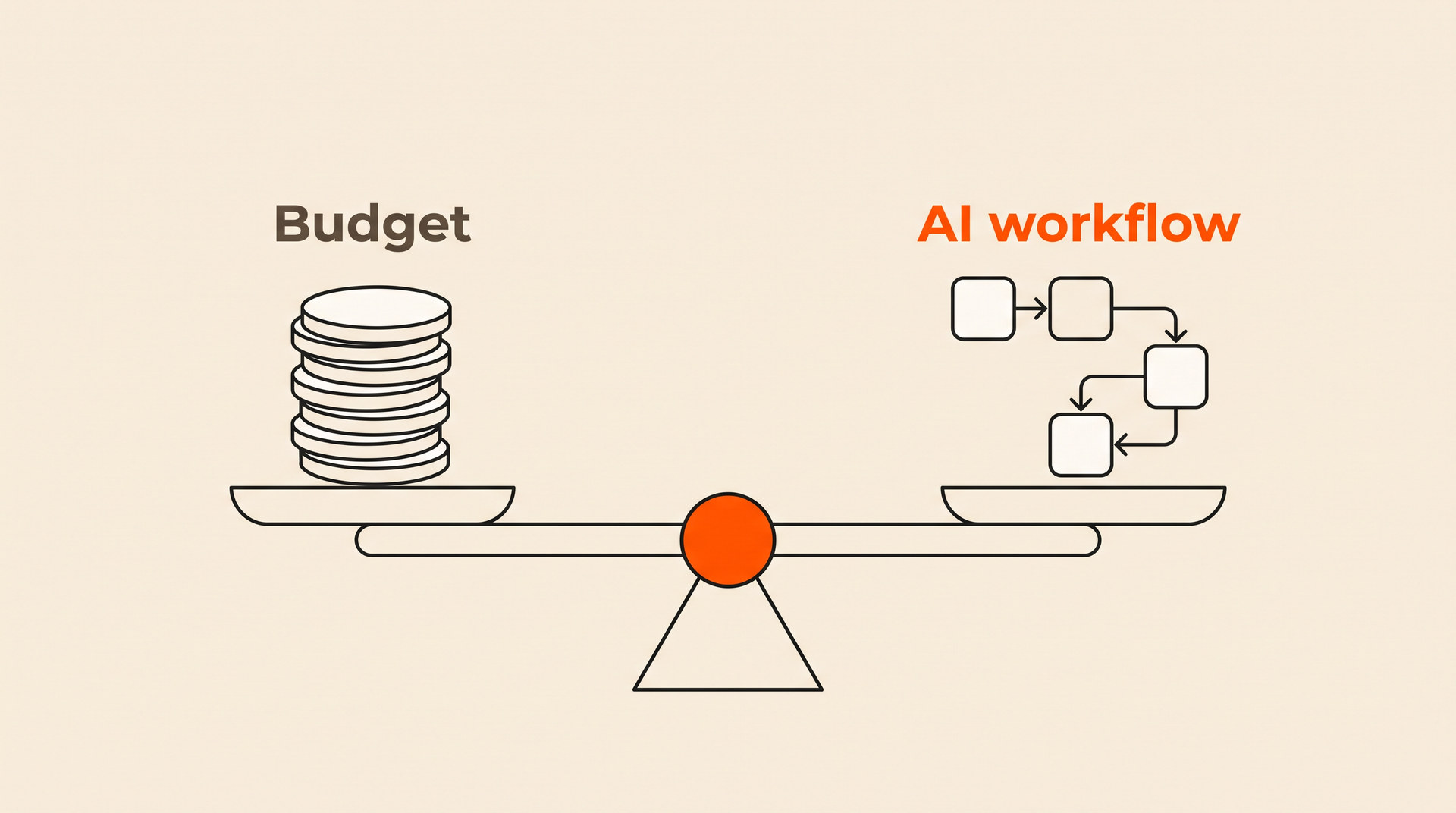
The Economics of AI Implementation
Your team is drowning in manual triage. Leads pile up, follow-ups lag, and your sales cycle stretches while competitors automate. The gap isn't strategy: it's execution speed. As you look to hire external expertise, you are met with a highly fragmented consulting market where pricing structures vary wildly and the signals are easy to misread. To make the right investment, you need to understand the financial mechanics behind the typical ai consultant hourly rate, project fees, and retainers, and how each pricing structure directly shapes consultant behavior.
95% of generative AI programs fail to deliver bottom-line returns (Harvard Business Review, "What Companies with Successful AI Pilots Do Differently").
That failure rate is not a technology problem. It's a structural one: a direct consequence of what practitioners call the "discovery trap," where traditional consulting firms spend months in open-ended, billable discovery phases, exhausting budgets before delivering a single line of production code. When evaluating the cost of AI consulting services, business leaders need to look past simple price tags and analyze how different pricing models align incentives with actual operational outcomes.
1. Deconstructing the AI Consultant Hourly Rate and Pricing Models
1.1 The Hourly Rate Model: Incentives and Risks
The ai consultant hourly rate spans a wide range, ranging from independent specialists on platforms like Upwork who handle basic integrations to global strategy houses with enterprise procurement processes that demand extensive overhead. That range reflects genuine differences in seniority, production-grade experience, and delivery accountability.
Hourly billing rewards thoroughness. A consultant paid by the hour has every incentive to research carefully, document exhaustively, and explore edge cases. The problem is structural: there is no financial penalty for taking longer. Scope stretch isn't malicious; it's the natural output of a model where time is the billable unit. Compounding this, underpriced hourly rates frequently signal that junior developers are operating behind a senior-labeled engagement, a pattern that only surfaces when delivery timelines slip.
Contractual counterweights matter here. Capping hourly projects at a defined ceiling and requiring weekly burn-rate reports shifts accountability without abandoning the model entirely. Without those guardrails, open-ended hourly engagements are where AI budgets quietly disappear.
1.2 The Fixed-Price Project Model: Efficiency vs. Scope Cutting
Fixed-price AI consulting locks implementation costs upfront against a specified scope of work. The behavioral incentive flips: the consultant now profits from speed and efficiency, not from hours logged. Speed dictates the timeline. For well-defined, single use-case builds, such as connecting an ERP to a workflow automation tool, this model tends to produce the fastest path from brief to deployed solution.
The risk runs in the opposite direction. When unexpected technical complexity surfaces (and in AI integration work, it usually does), fixed-price engagements can produce friction or, worse, quiet scope-cutting where the delivered solution technically satisfies the contract but falls short of the operational intent. Preventing that requires defining "done" in highly objective, written terms before the engagement starts, alongside a pre-negotiated change-request process with clear pricing for out-of-scope additions.
1.3 The Retainer Model: Continuity vs. Open-Ended Drift
Retainer arrangements are designed for long-term, continuous optimization and strategic advisory, which is the exact kind of ongoing alignment that post-deployment scaling of agentic workflows genuinely requires to remain effective as business needs evolve. A well-structured retainer rewards deep partnership: the consultant stays close to your operations, foresees integration needs, and compounds value over time.
The failure mode is drift. Without active accountability mechanisms, a monthly retainer can become a recurring invoice attached to a standing meeting and a quarterly slide deck. Tying retainer renewals to specific monthly milestone achievements, rather than to time elapsed, redefines the relationship. Rolling handovers and multi-month reviews add further structure. Used correctly, retainers make sense after deployment, not before it. Timing is everything.
2. Factors Influencing AI Consulting Rates and Budgeting Strategies
2.1 Key Variables Driving Average AI Consultant Fees
Technology complexity is the most apparent cost driver. Simple builds cost less. Building a custom neural network for proprietary data pipelines carries different overhead than deploying low-code workflow automation tools for business processes. Data readiness, legacy ERP integration complexity, and the level of required human-in-the-loop oversight each add layers of cost that aren't always visible in a headline rate.
The hidden costs deserve equal attention. Model API usage, infrastructure hosting, internal team training, and change management sit entirely outside the consultant's fee, yet they often represent 30 to 50% of total implementation spend for organizations that did not account for them. Framing the decision purely around consulting fees misses the most significant number on the table: the ongoing cost of inaction. Manual bottlenecks and lost revenue from delayed automation compound every quarter you defer the investment.
2.2 Tactical Steps on How to Budget for AI Consulting Services
- Map before you build. Start with a structured enterprise AI audit to document existing workflows and rank AI use cases by ROI in dollars, rather than by strategic narrative. Without this foundation, budget allocation is guesswork.
- Prioritize high-impact, low-complexity wins first. Engaging a certified n8n automation agency to automate repetitive manual entry can reduce triage time by 40%, the kind of measurable return that justifies further investment and builds internal confidence.
- Reserve 20 to 30% of the total budget for post-implementation work. Testing, evaluation harnesses, and user adoption are not optional line items: they determine whether a deployed workflow actually gets used. Adoption drives value.
- Require production-grade deliverables, not presentations. A portfolio of demos in masquerade, meaning polished slide decks with no working code behind them, is the clearest sign that a consulting engagement has drifted into the discovery trap.
2.3 Navigating the AI Strategy Consulting Pricing Breakdown
A well-structured AI engagement moves through three separate budget phases: strategy and scoping, development and integration, and post-deployment optimization. Traditional consulting firms tend to front-load the first phase, sometimes consuming the majority of the budget before integration work begins. Rapid-prototyping models invert this, compressing discovery into a fixed, time-boxed sprint and moving to working code within weeks. Speed reduces risk.
The phased approach protects capital in a specific way: each phase must demonstrate its own financial return before the next portion of budget is released. That structure forces clarity on both sides and prevents the slow accumulation of billable consulting hours that characterizes failed AI programs that never deliver a working product.
3.1 Bypassing the Discovery Trap with Velocity-Driven Models
Traditional consulting's discovery phase has a valid purpose: understanding the client's environment before prescribing solutions. The problem is duration. When discovery stretches across months of billable time, it stops being due diligence and starts being the product. Budgets erode, stakeholder patience thins, and the actual automation work never begins. Momentum dies.
A velocity-driven, fixed-scope model bypasses this entirely. Rather than billing for the journey toward a recommendation, the engagement commits to a specific, production-ready deliverable within a defined window. Ovidius AI operates as an extension of your team, committing to deliver working solutions in under 30 days. That timeline is not a marketing claim: it is a structural limitation that forces prioritization and eliminates the open-ended discovery billing that consumes traditional AI programs before they produce anything.
3. The Antidote to Discovery Drift: ROI-First AI Delivery
Navigating AI consulting costs does not have to be a high-risk venture or an open-ended financial commitment. You have options. Understanding the behavioral incentives baked into hourly rates, project fees, and retainers gives you the ability to choose a model that aligns with your operational goals, and to build contractual guardrails that keep any model accountable. If you are ready to stop paying for slide decks and start deploying agentic, low-code AI workflows that deliver measurable ROI, book a discovery call with the Ovidius AI team today.
Stop Paying for AI Slide Decks. Start Building.
Do not let your AI initiatives get stuck in the 95% failure trap. At Ovidius AI, we bypass the traditional consulting discovery delay by acting as an extension of your team, delivering working solutions in 30 days. Whether you need a structured, eight-phase AI Audit to map your workflows or a rapid-prototyping sprint to automate repetitive manual entry, we focus on tangible results and clear returns on investment. Schedule a consultation with our expert team today to kickstart your automation journey.
Footnotes
- Harvard Business Review, "What Companies with Successful AI Pilots Do Differently" (September 2025). Harvard Business Review.