AI Implementation Partner vs Vendor: What Decides Whether Your AI Gets Adopted

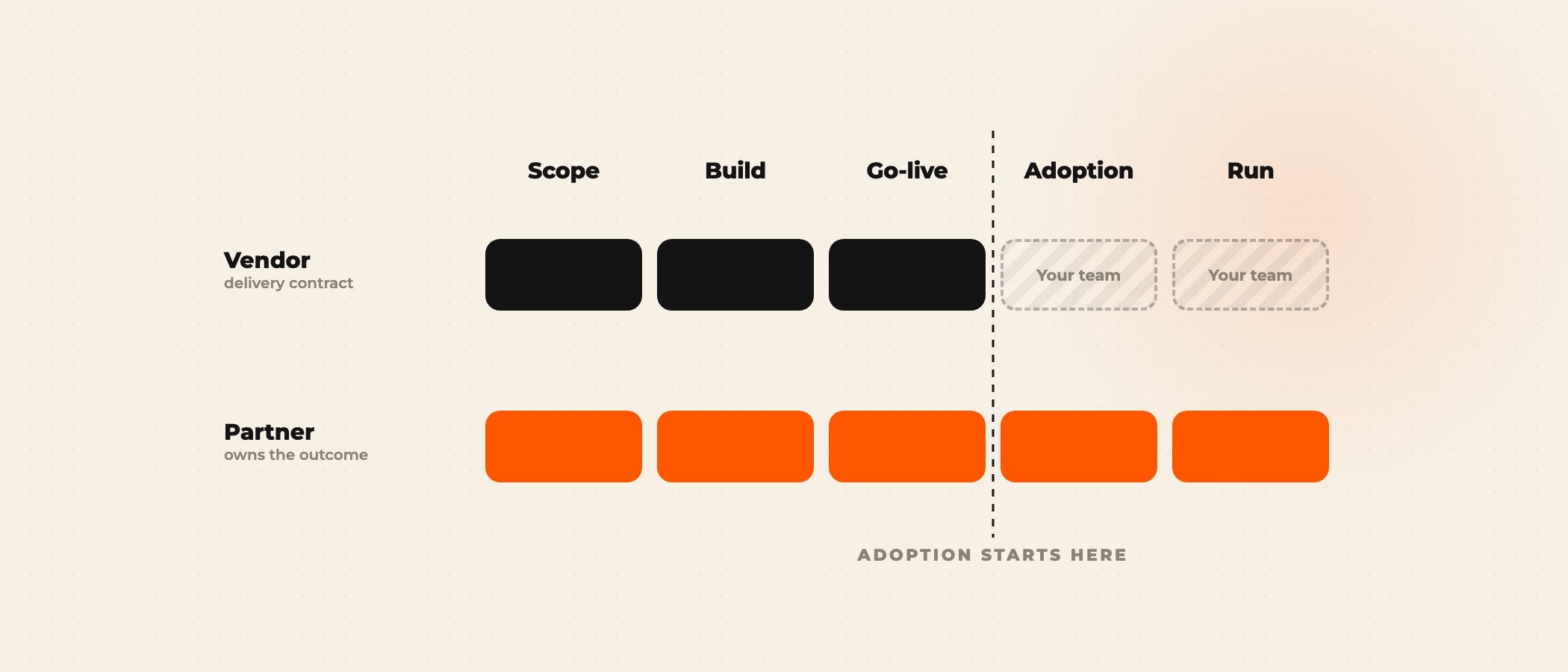
An AI vendor sells you a system and leaves when it is switched on. An AI implementation partner is still there when your team has to change how it works around that system, and that second stretch is where most enterprise AI projects stall. For its 2025 report The GenAI Divide, MIT's Project NANDA reviewed over 300 public AI initiatives, interviewed 52 organisations and surveyed 153 senior leaders. It found that only 5% of integrated AI pilots were extracting millions in value, while 95% of organisations saw no measurable effect on profit and loss.
The report blames the approach more than the models: tools that do not learn from feedback and do not fit into daily workflows. It also found that tools built with external partners reached deployment about 67% of the time, against about 33% for tools built internally. The figures are self-reported and the authors say the link is a correlation, not proof of cause, but the direction is hard to ignore. Before you compare demos or day rates, the useful question is which parts of the work each contract leaves with your team.
What a vendor contract covers, and where it ends
A software vendor, or an integrator delivering one vendor's product, works to a bounded scope: configure the system, connect it to your data, test it and switch it on. The contract is fulfilled at go-live. That is a fair deal for a standard tool, and many tools need nothing more.
The trouble starts when the system changes how a team works. Someone has to redesign the workflow around it, train each role on real cases, decide who handles the exceptions and keep tuning the rules as the business changes. In a delivery contract that work lands on your internal team, who are already carrying their day jobs and the systems they run.
In S&P Global Market Intelligence's 2025 survey of 1,006 companies in North America and Europe, 42% said they had abandoned most of their AI initiatives, up from 17% a year earlier, and the average company scrapped 46% of its proofs of concept before production. Gartner predicted in July 2024 that at least 30% of generative AI projects would be abandoned after proof of concept by the end of 2025, citing poor data quality, inadequate risk controls, escalating costs and unclear business value. Each of those causes sits after the demo, in the part of the project a delivery contract does not cover.
What an AI implementation partner adds
A partner takes responsibility for the system being used, not only for it being built. In practice that means four kinds of work, written into the scope with names and dates.
| Work | What it involves | Who does it in a delivery contract |
|---|---|---|
| Workflow redesign | Mapping how the work runs today, then changing the steps, owners and approvals around the system | Your team, after go-live |
| Training per role | Sessions for each role on their own cases, plus what to do when the system is wrong | Often a recorded walkthrough |
| Rules the business owns | Thresholds, routing and approvals moved to a place the team can edit without a developer | A change request to the vendor |
| Run and improve | Monitoring, error alerts, a log of every run and a person who tunes the system as the business changes | A support ticket queue, or nobody |
McKinsey's March 2025 State of AI report tested 25 attributes and found that redesigning workflows had the biggest effect on whether a company saw an EBIT impact from generative AI. Only 21% of companies using it had redesigned any workflows at all.
The third row is the one buyers skip and later regret. When IES Limited wanted daily alerts on its management information pack, Ovidius built the thresholds into a control panel finance could edit. IES made 34 threshold changes in the first six weeks without raising a single developer ticket. The full build is on the IES daily MI alerting case.
BCG's AI at Work 2025 survey of more than 10,600 employees points the same way: regular use was sharply higher among people who received at least five hours of training, while regular use among frontline employees stalled at 51%. Plan training as part of the project, with dates before go-live.
Eight questions to ask any AI provider
Put these to every provider on your shortlist and ask for the answers in the proposal. A yes means the work is written into the contract with an owner, not promised on the call.
A provider can score low here and still be the right choice. If you are buying a standard tool, such as a helpdesk with a built-in AI agent, a delivery contract and a good internal owner are often enough. Our guide to build vs buy for enterprise AI covers when buying beats building.
When a vendor is the right choice
Choose a vendor when the workflow already exists in a standard form, the system works out of the box and your team has someone with the time to own the rollout. Choose a partner when the AI has to fit how your company works: your rules, your systems of record and approvals that differ from the next company's. That second case covers most of the work that produces a return, because it changes a process rather than adding a tool.
Before picking either, find out which workflow is worth automating first. Our AI use case canvas lays out one use case on a page, and the AI readiness scorecard scores your data, systems, workflows, people and governance in ten questions.
How Ovidius works as an implementation partner
Ovidius starts with the AI Audit: four to eight weeks that map your processes and rank the use cases, ending in a 90-day roadmap you own. Where a use case needs proving, an AI proof of concept runs two to six weeks on your data. The build runs inside your own systems and accounts, and AI managed services keep it running afterwards, with a named owner and a log of every run.
Each stage has one owner on our side, set out on how we work. For GoKickflip that meant a content pipeline that took articles from $700 to $12.11 each, with the SEO lead back on strategy instead of managing freelancers, as the GoKickflip case shows.
Frequently asked questions
What is the difference between an AI vendor and an AI implementation partner?
A vendor delivers a system and its contract ends at go-live. An implementation partner also owns what happens after: redesigning the workflow, training each role, moving rules to where the business can change them, and running the system once it is live.
Why do AI projects fail after deployment?
Most stall on adoption rather than on the model. MIT Project NANDA's 2025 study traced the gap to tools that do not fit daily workflows or learn from feedback, and Gartner named data quality, risk controls, cost and unclear value as the reasons generative AI projects are abandoned after proof of concept.
How do I choose an AI implementation partner?
Ask each provider whether they redesign the workflow, whether training per role is in scope, which adoption measure the contract names, who owns the system for 90 days after launch and whether your team can change the rules without a developer. Ask for the answers in writing.
Is an AI partner more expensive than a vendor?
The contract usually costs more, because it covers more of the work. The comparison that matters includes the internal hours your team spends on adoption under a delivery contract, and the cost of a system nobody uses.
When should I buy an AI tool instead of hiring a partner?
When the workflow is standard, the tool works out of the box and someone on your team has time to own the rollout. A helpdesk AI agent or a meeting summariser often fits that description.
If you are weighing providers for a specific workflow, book a discovery call. Jason will ask what the workflow is, what it costs you today and who would own it after launch, and tell you whether you need a partner at all.