Customer Service AI Agents: What Can They Actually Resolve Without a Human?
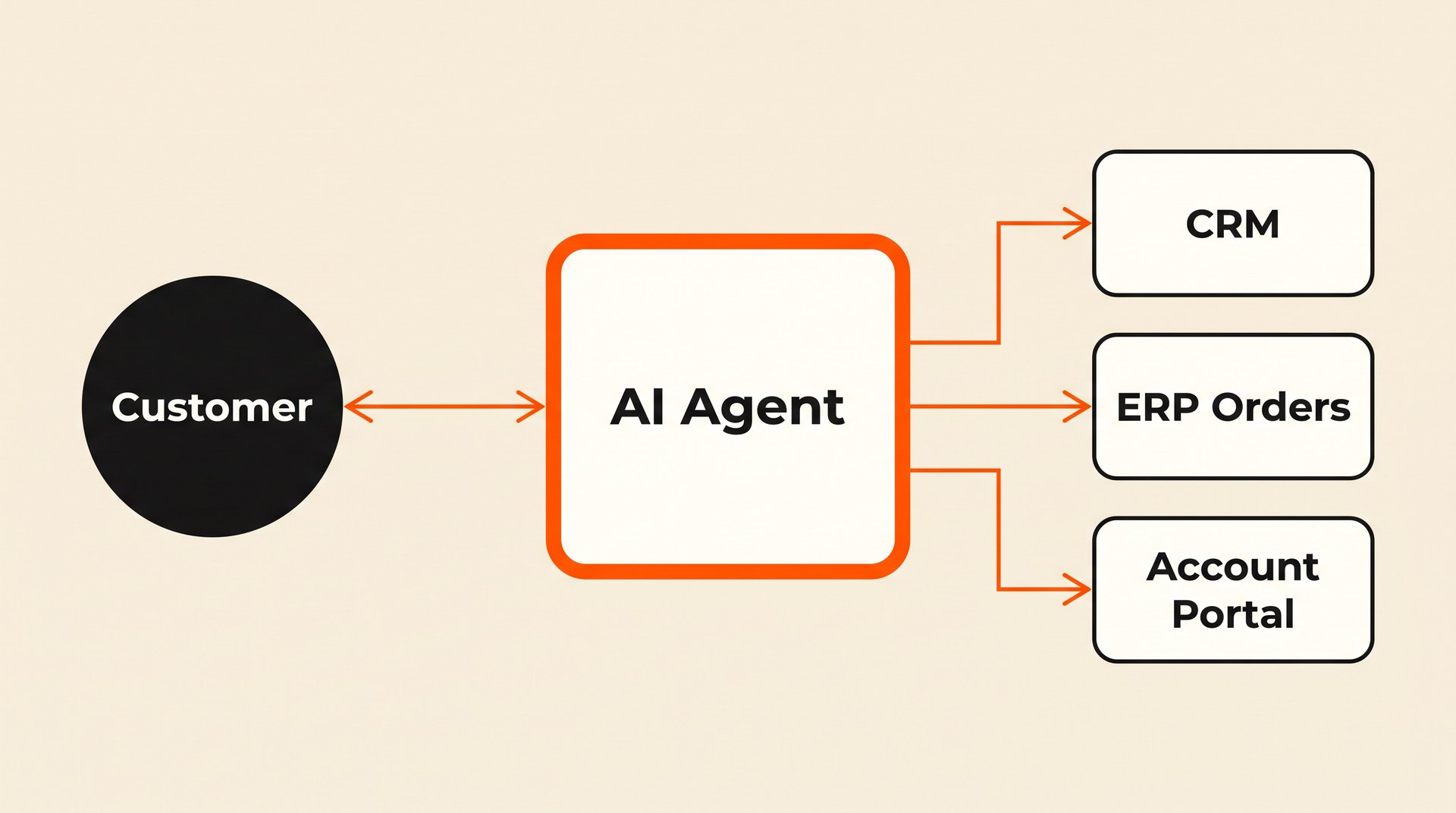
Beyond Chatbots: The Architecture of Autonomous Resolution
Support queues do not back up because your team is slow. They back up because a massive share of incoming requests, including order status checks, return initiations, and account updates, are structurally identical. Yet, each one still lands in a human queue. Operational costs climb not from complexity but from volume, and that volume is, by definition, automatable.
Many organizations have tried to address this with chatbots and walked away underwhelmed. The bot deflects a few FAQs, frustrates customers who need actual resolution, and the pilot quietly dies. That failure is not an indictment of AI customer support automation broadly; it is an indictment of deploying the wrong architecture for the job.
A modern customer service AI agent resolves complex requests end-to-end, but maintaining customer lifetime value requires a precise, governed escalation boundary.
Industry Shift Worth Noting: The defining transition in enterprise support automation is not from no-bot to bot. It is the shift from conversational deflection to backend execution. Legacy FAQ systems matched keywords to canned responses. Modern smart automation acts like a tireless team member, calling APIs, writing back to databases, and closing tickets; it handles repetitive tasks 24/7 so your people focus on strategy, executing actions at machine speed with full documentation. That architectural gap is what separates a pilot that stalls from a production-ready workflow that reduces costs measurably.
Traditional script-based chatbots operated on decision trees. Every possible path had to be pre-authored; anything outside that map produced a dead end or a frustrating loop. Modern AI agents operate on a different paradigm. They reason across structured knowledge graphs, interpret multi-turn conversations without losing context, and select the appropriate tool, such as an API call, a database query, or a form submission, based on what the customer needs rather than which keyword they typed. The difference is not cosmetic. An agent grounded in an enterprise context layer understands your product taxonomy, your policy logic, and your backend data relationships well enough to act on them, not just describe them.
Autonomous Execution: What an AI Agent Resolves End-to-End
When a customer service AI agent executes a task, it is not pasting a response from a knowledge base. It takes direct action. It is making a governed API call to your order management system, your CRM, or your returns portal, reading live data and writing back to it. That distinction matters because it is what produces real resolution rather than a holding response that still requires a human to take action downstream.
The security objection emerges immediately in most enterprise conversations, and it is legitimate. Governed agent platforms address it through scoped API permissions: the agent is authorized to perform specific, predefined actions on specific data objects, and every action is logged with a full audit trail. There is no broad database access and no uncontrolled writes. Security remains intact. Deploying this architecture also does not require a full system migration; it layers onto your existing CRM and order management infrastructure through standard API integrations.
Order tracking is the clearest illustration of what AI customer support automation delivers at scale. A customer asks where their shipment is; the agent authenticates the request, queries the order management system in real time, and returns the current status, including carrier updates, without a human touching the ticket. Return initiations follow the same pattern: the agent checks eligibility against your return policy, generates a return authorization, and sends the customer a prepaid label, all within a single conversation. Account detail updates, such as email changes, address corrections, and preference adjustments, are handled the same way. These are not edge cases; for most e-commerce and SaaS support operations, they represent the majority of inbound volume. Automating order tracking and returns alone can materially reduce costs and free your team's hours for work that requires human judgment.
The core pillars that make this possible are three: reasoning (the agent's ability to interpret ambiguous language and select the right action), tool use (the governed API calls that execute that action in your systems), and guardrails (the confidence thresholds and compliance rules that determine when the agent should act versus when it should stop and hand off). Ovidius AI's approach to resolution engineering treats these three components as inseparable: a production-ready workflow is not functional without all three operating together.
The Escalation Boundary: When to Bring in Human Support
No AI agent should operate without an explicit escalation threshold, and designing that boundary is as important as designing the automation itself. When an agent reaches the edge of its authorized scope, whether due to a request it cannot confidently classify, a policy exception requiring discretion, or a customer whose emotional state signals that speed is the wrong priority, it must transfer cleanly and immediately to a human rep with full context intact.
Automated guardrails and compliance checking are what keep the agent inside safe operational limits before that boundary is reached. Every action the agent considers passes through a compliance layer that validates it against your policies and regulatory requirements before execution. For organizations operating in regulated industries, this is not optional architecture; it is the foundation that makes deployment viable. Ovidius AI's work on compliance-first AI content reflects the same principle applied across content and operational workflows: the guardrail is not a constraint on capability, but rather what makes the capability trustworthy.
Scenarios that require immediate human escalation:
- High-emotion complaints or sensitive escalations where the customer's distress level signals that resolution speed is secondary to empathetic engagement; the agent detects sentiment signals and routes the ticket automatically.
- Complex, multi-system billing disputes that require cross-referencing transaction records, applied credits, and contractual terms in ways that demand human judgment rather than rule-based logic.
- High-value account changes or security overrides, such as modifications to payment methods, ownership transfers, or identity verification requests that carry fraud risk and require human authorization.
- Requests that fall outside defined policy scope: novel situations, regulatory gray areas, or anything the agent's confidence scoring flags as below threshold for autonomous action.
Human-in-the-loop customer service AI is not a fallback for when the agent fails. It is a strategy. It is a deliberate architectural choice that protects customer lifetime value by ensuring the right type of intelligence, human or machine, handles each interaction. Your team is not replaced by the agent; the agent acts as an extension of your team, handling the volume that would otherwise consume their capacity, leaving them free for the interactions that genuinely need them.
Automating repetitive, database-driven requests does not just reduce costs; it changes what your human support team spends their day doing. When an agent handles the order tracking queue, the returns flow, and the routine account updates, your reps are no longer burning hours on transactions. They are handling the billing dispute that requires three-way coordination, the enterprise account renewal that needs a relationship conversation, and the complaint that needs genuine empathy and creative problem-solving. That is a meaningful shift in role quality, not just workload. Reps focus on relationships.
The concern about role displacement is real and worth addressing directly. AI customer support automation will reduce the total volume of work that requires a human touch; that is the point. What it will not do is eliminate the need for human judgment in support operations. Roles are evolving toward handling complex, high-empathy, and high-stakes escalations: the interactions where a customer's long-term relationship with your brand is decided. Organizations that deploy this architecture strategically tend to find that their human reps become more effective, not redundant, because they are no longer diluted across low-value transaction volume.
Implementing AI Agents for Customer Queries: Best Practices
Start with your most frequent, lowest-variance request types, such as order tracking, return initiations, password resets, and account updates. These are the workflows where the resolution path is well-defined, the API integrations are direct, and the measurable ROI is immediate. Define your escalation triggers before you deploy, not after. Plan ahead. Map the compliance requirements for your industry and build the guardrail layer first. And treat the human handoff as a first-class feature of the system, not an afterthought; the quality of the context transfer at escalation is what determines whether the customer experience holds together across the boundary.
Resolution engineering, done correctly, produces a support operation that is faster for customers, less costly to run, and more engaging for the human reps who remain in the loop. The organizations that get the most out of their customer service AI agent deployments are the ones that treat the escalation boundary as carefully as they treat the automation itself: that is where customer lifetime value is either protected or lost.
Ovidius AI delivers production-ready workflows in 30 days. We move fast. Clients who've gone through this process describe the experience in terms that go beyond the technical:
"From day one, the Ovidius team moved fast, thought big, and executed with precision. Together, we built something truly cutting-edge that will be a major catalyst for our business.", Renaud, Founder & CEO, GoKickflip
"By using their AI-driven content for our travel insurance sites, we’ve completely phased out our reliance on external agencies and freelancers in 2026 while significantly speeding up production.", Bhavek Rughani, Head of Marketing, IES Limited
The formula remains consistent: clear scope, governed architecture, and a team that executes rather than theorizes.
Ready to map your automation boundary?
Take our AI readiness assessment to identify which high-volume request types in your support queue are ready for immediate API-driven automation. Or book a discovery call to walk through your current workflows with the Ovidius team.
: Download the "AI Agent Resolution Capability Audit Checklist" to identify which high-volume requests are ready for immediate API-driven automation.
Footnotes & Methodology Notes
No verified third-party statistics were available for this topic at time of publication. All trend observations in this article are qualitative, drawn from the structural characteristics of modern agentic AI architectures and the operational patterns of enterprise support deployments. This section will be updated with production metrics once verified figures are established.
About the Author
The Ovidius AI team, Owen, Jason, Ben, Oskar, and Maciej, specializes in deploying production-ready agentic AI workflows for enterprise CX and operations teams across North America, Latin America (LATAM), Asia-Pacific (APAC), Europe, Australia, New Zealand, Israel, and the United Arab Emirates. Their work sits at the intersection of AI strategy, compliance-first architecture, and measurable operational transformation.