The Agentic Service Desk Chatbot: Reclaiming Enterprise Hours with Intelligent Automation
The Cost of Scattered Knowledge
Every enterprise suffers from the same structural wound: knowledge scattered across disconnected systems. SharePoint folders sit unaudited since 2021, while authoritative answers are buried under forty replies in Slack threads. HR handbooks live in PDFs no one can find, and critical IT runbooks exist only in the memory of an engineer who left three jobs ago.
Employees do not stop working when they cannot find what they need; instead, they interrupt a colleague who might have the answer. This interruption multiplies. A password reset that should take ninety seconds turns into a fifteen-minute exchange across two time zones, and a benefits question with an existing written answer generates a support ticket that sits in a queue until Tuesday.
A modern service desk chatbot addresses this not by creating another knowledge repository, but by acting as a conversational layer over the infrastructure you already have. It operates as an extension of your team that surfaces the correct answer, from the correct system, the moment an employee asks. This distinction matters. Rigid Q&A bots that pattern-match against static FAQ lists have existed for years, and most IT and HR leaders have the scar tissue to prove they do not scale. Today, the critical shift is the capacity for an agentic, low-code AI workflow: multi-step, autonomous task execution that goes well beyond answering questions to resolve them directly.
"Pre-deployment AI testing cannot fully account for real-world user interactions and non-deterministic model behaviors. Continuous, ongoing post-deployment monitoring is critical to validate that systems operate reliably in production."
NIST AI 800-4, Artificial Intelligence System Evaluation and Monitoring
The Architecture of Modern Conversational Support
An enterprise chatbot is an AI-powered conversational system built to automate tasks, answer questions, and support employees by integrating directly with enterprise data, applications, and workflows, according to IBM Think's analysis of enterprise chatbot architecture. Rather than requiring employees to navigate separate portals or ticketing interfaces, these systems operate as an accessible conversational layer inside the platforms your workforce already uses: Slack, Microsoft Teams, and email. The chatbot meets employees where they are, not where the system demands they go. This drives immediate adoption.
What makes this architecture fundamentally different from earlier generations of helpdesk bots is the combination of machine learning, natural language processing, and natural language understanding working in concert. The system identifies intent, not just keywords, and maintains conversational context across a session so a follow-up question does not restart the entire exchange. Grounding that capability in structured, verified company data is what separates a genuinely useful deployment from one that hallucinates policy details. That is precisely the function of an enterprise context layer: a structured data architecture that anchors model responses to verified internal sources rather than leaving the model to reason freely from its training weights. Think of it like a courtroom reporter who only records what is spoken in the room, rather than guessing based on rumors outside.
1. Streamlining IT and HR Support with Agentic Workflows
Automating the Repetitive IT Workload
The volume of repetitive requests hitting IT service desks is not a minor inefficiency: it is a structural drain on engineering capacity. Password resets, software access provisioning, and system status inquiries represent a significant share of total ticket volume, and IBM Think's research on enterprise chatbot use cases confirms these are the requests internal chatbots handle most effectively. They are high-frequency, low-complexity, and almost entirely rule-bound, making them ideal candidates for full automation. This is low-hanging fruit.
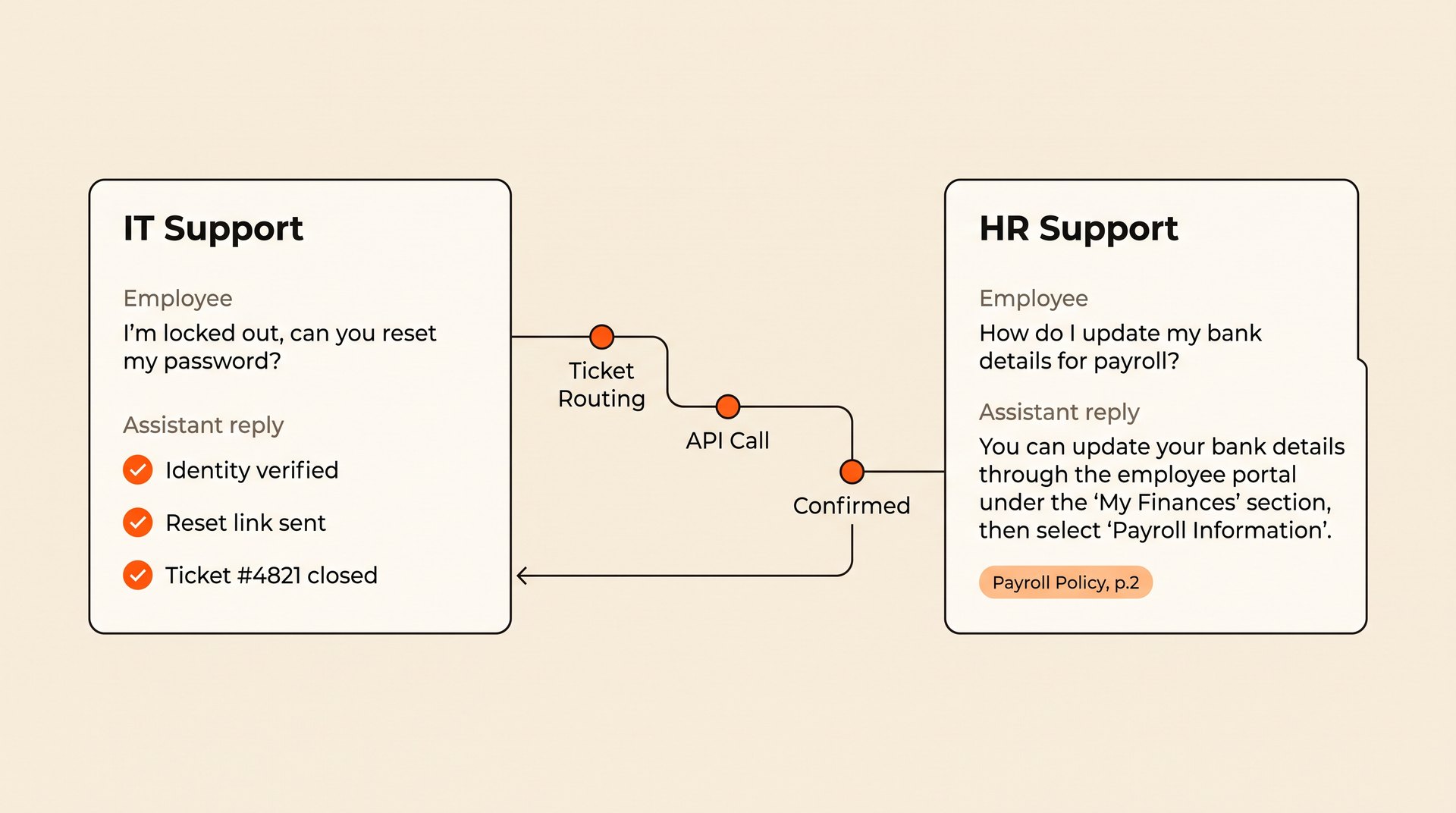
An IT help desk chatbot password reset workflow, for instance, can run end-to-end without human involvement: verifying user identity through an integrated identity provider, resetting credentials, and confirming the action, all within the same Slack or Teams thread where the employee asked. The employee gets resolution in under two minutes, and the IT engineer never sees the ticket. This is not a marginal improvement: it is a structural shift in how IT capacity gets allocated. Automating repetitive employee questions at this level delivers a clear return on investment and measurable efficiency gains by reclaiming engineering hours for the work that truly requires human judgment: diagnosing infrastructure failures, managing vendor escalations, and building the next layer of automation.
Simplifying HR Inquiries and Employee Onboarding
HR service desks carry a different burden. The questions are less technical but no less time-consuming: benefits enrollment windows, parental leave policies, onboarding checklists for new hires across three different jurisdictions, and system access requests that require manager approval. IBM Think's enterprise chatbot documentation identifies these as core HR automation use cases, and the friction they generate is unbalanced relative to their real complexity.
An internal chatbot deployed on the HR service desk uses advanced Retrieval-Augmented Generation (RAG) to scan employee handbooks, policy documents, and HR knowledge bases in real time, returning precise, context-aware answers rather than generic summaries. An employee in Singapore asking about their parental leave entitlement at 11 PM local time gets the same quality of response as one asking the same question in Amsterdam during business hours. As the time zone problem dissolves, the HR team's Monday morning inbox no longer fills up with questions that have written answers that were simply unfindable until now.
The onboarding use case alone often justifies the deployment. New hires generate a concentrated burst of repetitive questions over their first thirty days regarding system access, org chart navigation, benefits enrollment, and compliance training deadlines. Routing all of that through an automated policy guidance chatbot removes the cognitive load from HR coordinators and gives new employees faster, more consistent answers from day one.
The Power of Deep System Integration
The capability ceiling of a service desk chatbot is determined almost entirely by the depth of its integrations. A chatbot that can only retrieve information from a static knowledge base is merely a search engine with a conversational interface. What distinguishes an enterprise-grade deployment is the ability to connect with CRM platforms, ERP systems, HR platforms, ticketing tools, and knowledge bases via APIs, triggering real-time actions instead of just returning cached answers, as IBM Think's enterprise chatbot research makes clear. Think of it like building with LEGOs instead of custom carpentry; you connect existing blocks rather than carving them from scratch.
That integration depth is what enables agentic behavior. Instead of telling an employee how to request software access, the chatbot can initiate the access request, route it for manager approval, confirm provisioning, and notify the employee, all within a single conversation thread. Advanced implementations incorporate AI agents capable of executing multi-step workflows and completing tasks autonomously within defined rules, according to IBM Think. The chatbot stops being a simple front-end interface and becomes an operational layer that executes work.
2. Ensuring Security, Compliance, and Seamless Escalation
Graceful Human Escalation and Triage
Automation has a boundary. Complex employee relations issues, nuanced technical failures, and anything requiring managerial discretion sit outside it, and a well-designed service desk chatbot is built with that boundary in mind. When a query reaches the edge of what automation can reliably handle, the system executes a smooth handoff: the full conversation history, including every prior exchange and any data already collected, transfers to the human agent before they type their first response. This human-in-the-loop integration eliminates the need for the employee to re-explain their issue or for the agent to perform duplicate data entry. IBM Think's analysis of enterprise chatbot design identifies this context-preserving handoff as a defining characteristic of production-grade deployments.
Automated ticket triage chatbots extend this further. Unresolved issues do not just escalate: they get categorized, prioritized, and routed to the correct IT or HR queue based on issue type, urgency, and team availability. The support pipeline becomes self-organizing for the cases that fall within defined parameters, which represent the majority of inquiries.
Key Capabilities of an Enterprise-Grade Chatbot
- Deep API Integrations: Connects directly with existing ticketing tools, ERPs, and HR platforms to trigger real-time actions and retrieve personalized, user-specific data instead of generic responses. (IBM Think, Enterprise Chatbot Architecture)
- Omnichannel Deployment: Operates natively inside Slack, Microsoft Teams, or email. Employees do not have to learn a new system or navigate a separate portal because the chatbot surfaces inside the tools they already use. (IBM Think)
- Customizable and Low-Code: Built on a low-code, easy to modify architecture that allows your operations team to adapt workflows as business requirements shift, without waiting on a development sprint.
- Unified Enterprise AI Solutions: Leverages broader enterprise AI solutions to unify knowledge management across fragmented systems and automate complex, multi-step employee requests that span multiple platforms.
- Multilingual Support: Essential for global organizations operating across diverse geographic regions. Consistent service delivery and compliance with local organizational policies require language capability that extends beyond English. (IBM Think)
Security and Compliance in Regulated Sectors
Handling sensitive employee data through an automated system introduces compliance obligations that cannot be treated as an afterthought. Service desk chatbots operating in regulated environments must meet strict security standards, including granular access controls, data protection, and full auditability, particularly under HIPAA and GDPR, as IBM Think's enterprise chatbot compliance guidance outlines. The requirements are not optional, and they do not become less stringent because the system is internal-facing rather than customer-facing.
Ovidius AI approaches this through self-hosted infrastructure options that keep all data, documents, and model runs entirely within the client's secure environment. No data transits a public model, and nothing leaves your secure perimeter. For organizations in healthcare, financial services, or any sector where data residency is a procurement requirement, this architecture is not an optional feature; it is a prerequisite. Maintaining rigorous standards within automated AI workflows is an active discipline, not a checkbox, and it is one Ovidius treats as foundational to every deployment. For a deeper look at how that discipline translates into practice, compliance-first AI content covers the specific principles that govern how Ovidius builds and governs its AI systems.
Mitigating the Risks of Confabulation and Bias
Generative AI models deployed in enterprise settings carry a specific failure mode that deserves direct attention: confabulation. The model generates a response that is fluent, confident, and wrong, and an employee acts on it. In an IT context, that might mean following incorrect troubleshooting steps, while in an HR context, it might mean misunderstanding a leave entitlement. NIST's Generative AI Risk Management Profile (AI 600-1) identifies confabulation as a highly debated technical challenge, noting that these fabrications can mislead users into acting on erroneous policy or technical guidance.
Advanced RAG pipelines are the primary mitigation. By grounding every response in verified, retrieved company documents rather than allowing the model to reason freely from its training data, you constrain the output to what the organization has officially written and approved. The model cites rather than invents. Even so, RAG does not eliminate the problem entirely: retrieval quality, document currency, and query ambiguity all introduce their own failure modes.
Post-deployment monitoring adds the second layer of defense. Tracking detailed user interactions to detect anomalies and validate response quality is necessary, but it introduces a genuine tension. NIST AI 800-4 flags this directly: granular interaction logging can compromise user privacy, particularly when the chatbot is handling sensitive personal or corporate data. There is no clean resolution to that trade-off. Organizations need to define the minimum monitoring footprint that gives them sufficient signal to catch degradation, without building a surveillance layer on top of their own workforce.
Addressing Language Disparities in Global Deployments
Global enterprises face an additional layer of complexity that does not always surface in vendor demos: language performance is not uniform. Generative AI models exhibit significant performance disparities between high-resource languages like English and lower-resource languages or regional dialects, according to NIST AI 600-1's analysis of language performance gaps. An employee in Amsterdam may receive a substantively better answer than a colleague in Jakarta asking the same question in Bahasa Indonesia. This occurs not because the system was designed to favor one over the other, but because the underlying model was trained on vastly more English-language data.
That disparity has real operational consequences. It creates unequal service quality across the workforce and, in regulated environments, potential compliance exposure if employees in certain regions receive less accurate policy guidance. NIST AI 600-1 recommends that global enterprises actively monitor and evaluate chatbot performance across different language groups to mitigate representational harms. Rigorous post-deployment monitoring, as NIST AI 800-4 emphasizes, is the mechanism for tracking these variations over time: not as a one-time evaluation at launch, but as an ongoing operational discipline.
3. Deploying a Service Desk Chatbot That Actually Works
The Ovidius AI Partnership: Working Software in 30 Days
The strategic case for an internal chatbot on IT and HR service desks is well-established: continuous global availability, measurable reduction in manual ticket volume, and employee self-service that does not depend on someone being online in the right time zone. What is less established, in most enterprises, is a clear path from that strategic case to a working system in production.
Legacy ITSM suites have conditioned IT leaders to expect six-to-twelve-month implementation timelines, extensive professional services engagements, and a final product that still requires significant customization to match the organization's real workflows. That model made sense when enterprise software was monolithic and integrations were bespoke. It does not match the current landscape, where low-code orchestration layers and advanced RAG pipelines can be configured and connected to existing infrastructure in weeks.
Ovidius AI operates on a different foundation. Our goal is an internal chatbot that employees actively use, deployed in 30 days, not 6 months, rather than a demo environment or a pilot with a subset of use cases. This means the system is fully connected to your identity provider, ticketing system, HR platform, and document repositories from day one. We test the solution against real employee queries so it is monitored and ready to iterate immediately. Our team functions as an extension of your team, ensuring smooth integration with your existing systems and avoiding the friction of a detached third-party vendor managing a project from a distance.
The results speak directly to this collaborative model. One deployment partner shared their experience:
"Ovidius did in weeks what we couldn't build natively in Odoo for a full year. They architected an AI-powered n8n layer on top of our ERP that now schedules well over a thousand appointments a week automatically. They are our preferred AI delivery partner."
Leadership, Dutch Odoo Implementation Partner
This pattern holds across our engagements: rapid scoping, precise architecture, and working software in production. For IT and HR operations leaders who have watched chatbot pilots stall in procurement or fail during integration, this execution-led delivery model is what sets us apart.
Ready to Automate Your IT and HR Workflows?
Do not let valuable hours drain away to repetitive support tickets and knowledge scattered across disconnected systems. Partner with Ovidius AI to build a secure, high-precision internal chatbot tailored to your enterprise systems. We deliver working software in production within 30 days, complete with self-hosted options to guarantee absolute data sovereignty.
Book a discovery call to map your highest-volume support requests and design the right automation architecture for your organization.
Secondary CTA: Download our Enterprise IT & HR Chatbot Evaluation Checklist to audit your knowledge bases and identify your top candidates for automation.
Footnotes
[1] IBM Think: Enterprise Chatbots: IBM Think, Enterprise Chatbot
[2] NIST AI 800-4: Artificial Intelligence System Evaluation and Monitoring: NIST AI 800-4
[3] NIST AI 600-1: Generative AI Risk Management Profile: NIST AI 600-1
About the Author
Owen Co-Founder & AI Delivery Lead, Ovidius AI
Owen is a Co-Founder at Ovidius AI, where he leads the design and deployment of advanced agentic workflows and enterprise AI solutions. With a focus on rapid execution and strict data sovereignty, Owen and the Ovidius team help global enterprises automate complex internal operations and reclaim thousands of productive hours within 30 days.