Enterprise Chatbot Use Cases That Go Beyond FAQ Answers: The Rise of Autonomous AI Agents
Beyond the FAQ Widget
Most enterprise FAQ bots share the same core limitation: they answer questions that were anticipated in advance. When a user's actual need diverges even slightly from a pre-scripted path, such as a contract dispute, a multi-system data pull, or a live inventory check, the bot stalls, deflects, or loops. The frustration is familiar to any CTO who has watched a six-figure AI pilot collect dust after the pilot period ends. These pilots fail.
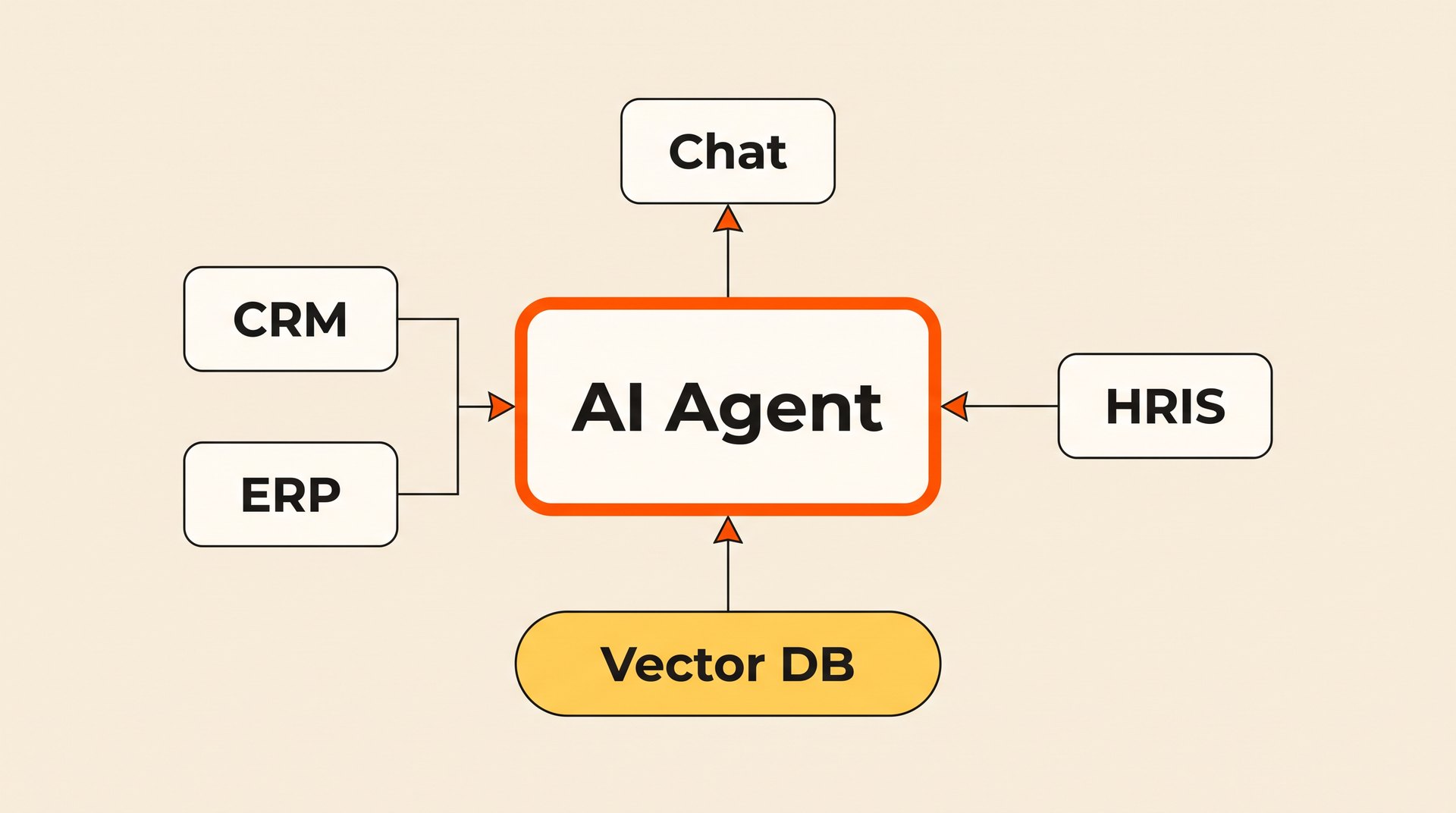
What's changed is the underlying architecture. Modern conversational AI agents do not retrieve from a static knowledge base: they query live internal repositories, execute transactions, and coordinate with other specialized agents across distributed systems, per the NIST AI Provenance and Traceability research and NIST AI 600-1. This shift is powered by Retrieval-Augmented Generation (RAG) and vector databases, which allow a conversational interface to securely interrogate internal documentation, customer records, and proprietary specifications in real time. The architecture underpinning this capability, what we call the enterprise context layer, determines how accurately and securely those queries resolve. Layered on top is the Model Context Protocol (MCP), a standardized framework for agent-to-agent (A2A) communication that lets multiple specialized chatbots collaborate and route requests without human triage, as documented in the NIST AI Provenance and Traceability research.
10x Reduction in manual verification time achieved by specialized AI agents like 'ChipStack' when automating complex engineering testbench generation and debugging workflows: NIST AI Provenance and Traceability research.
Building a real business case for chatbots means moving past customer service deflection as the primary metric. The enterprise chatbot use cases that generate tangible results and a clear return on investment cluster around three operational pillars: task completion, internal data retrieval, and intelligent request routing. Each pillar demands a different integration depth, and each carries its own security surface area: which is precisely why organizations that treat chatbot deployment as a plug-in exercise rather than an architectural one tend to stall.
1. Automating Complex Workflows: Chatbot Use Cases for Task Completion
The most compelling enterprise chatbot use cases aren't in customer-facing channels; they are in the operational core. Our agentic, low-code workflows act like a tireless team member who handles the repetitive tasks your staff dread, allowing your people to focus on work that directly moves the needle. Consider "ChipStack," an AI verification engineer that automates testbench generation, property verification, and debugging for semiconductor design teams. According to the NIST AI Provenance and Traceability research, ChipStack reduces manual verification time by 10x. That is not a productivity footnote: it is a structural reallocation of senior engineering hours from repetitive test cycles to design problems that require human judgment.
Cybersecurity operations present a comparable case. Security Orchestration, Automation, and Response (SOAR) platforms now use conversational interfaces to execute predefined incident-response playbooks, per the CISA Logging Reference Architecture. A security analyst can type a natural-language command to isolate a compromised endpoint, pull the relevant logs, and trigger remediation steps: actions that previously required navigating three separate consoles. This is the kind of multi-stage, agentic workflow automation that Ovidius AI structures through its agentic content pipeline as an extension of your team, where each stage in the chain is purpose-built and auditable.
HR and operations teams carry a quieter but equally significant administrative burden. Chatbot HR use cases like automated employee onboarding illustrate the pattern well: a conversational agent guides a new hire through document submission, writes the completed records directly to the HRIS, and provisions software licenses by communicating with the relevant internal systems, all without a single manual handoff. The hours reclaimed each week across a mid-size enterprise are not marginal. Manual handoffs disappear.
2. Secure Internal Data Retrieval and Intelligent Request Routing
Agentic RAG changes what "search" means inside an enterprise. Rather than returning a ranked list of document links, an AI agent running against a vector database synthesizes a direct answer, complete with source citations, pulled from live user guides, technical spec sheets, and customer documentation, as detailed in the NIST AI Provenance and Traceability research. The security caveat is worth stating plainly: extending retrieval through third-party plugins introduces meaningful risk, because inputs and content delivered through those plugins are frequently distributed with inconsistent or insufficient access controls, per NIST AI 600-1. Strict, role-based access controls at the enterprise context layer are not optional: they represent the difference between a governed retrieval system and an uncontrolled data exposure surface.
Intelligent routing scales this further through a coordinated network of specialized agents:
- Intelligent Routing with a "System of Agents": Enterprises deploy networks of domain-specific chatbots, rather than one generalist bot, to handle complex, multi-domain requests with appropriate depth and precision.
- Standardized Agent Communication: Specialized agents, such as Package, Floorplan, Schematic, and Physical Design agents in engineering contexts, coordinate task handoffs using the Model Context Protocol, per the NIST AI Provenance and Traceability research.
- Dynamic Task Allocation: A master routing agent parses the user's intent, identifies which specialist holds the relevant expertise, and transfers the task, without the user needing to know the architecture exists.
- Reduced Friction and Latency: Intelligent routing chatbot use cases eliminate manual triage queues, compressing resolution times and removing the operational bottlenecks that accumulate when requests land in the wrong queue.
Security and compliance requirements at this level are highly complex. The "WildChat" dataset, containing one million ChatGPT interaction logs, confirmed what practitioners already suspected: users routinely disclose sensitive personally identifiable information in conversational interfaces, per NIST AI 800-4. That behavioral pattern does not disappear in enterprise deployments. Organizations must implement logging architectures that capture user prompts, system prompts, model outputs, and every agent action, including calls to external functions, as specified in the CISA Logging Reference Architecture.
Human factors compound the technical challenge. Users under stress who receive an unhelpful chatbot response often exhibit sharply negative psychological reactions, and a meaningful segment of users will anthropomorphize the system in ways that distort their expectations over time, per NIST AI 600-1. The design response is practical: the system should clearly identify itself as an AI at every interaction boundary, maintain explicit escalation paths, and execute human-in-the-loop handoffs when the agent encounters high-stress or high-complexity scenarios it is not equipped to resolve autonomously.
Post-deployment monitoring is where many enterprise AI programs underinvest. Live environments are unpredictable. Pre-deployment evaluations in controlled environments cannot account for the non-deterministic behavior of generative AI in production: model drift, adversarial inputs, and emergent failure modes only surface at scale, per NIST AI 800-4. LLMOps and AgentOps frameworks address this by providing continuous visibility into functionality, operational performance, and security vulnerabilities in live environments, and they have become the operational standard for any enterprise running agents in production.
3. Overcoming the Operational Challenges of Advanced Chatbot Deployments
The path from FAQ bot to autonomous AI agent is clearly defined at this point. The harder questions are about governance, cost, and the limits of current tooling. One debate that technical leaders encounter quickly is the "monitorability tax": the trade-off between higher inference costs, or marginally lower model performance, and the non-negotiable requirement to maintain visibility into reasoning agent behavior, per NIST AI 800-4. There is no clean resolution to that trade-off yet; organizations have to decide where they sit on that spectrum based on their risk tolerance and regulatory exposure. Trade-offs are inevitable.
Two research gaps are worth acknowledging honestly. Tracking "interpretive drift", meaning how users progressively alter their behavior and expectations as they grow accustomed to interacting with autonomous agents, remains methodologically underdeveloped, per NIST AI 800-4. And securing AI systems in air-gapped or classified environments without introducing new privacy vulnerabilities is still an open problem. These are not reasons to delay deployment, but they are reasons to partner with an implementer who builds monitoring and governance into the architecture from the start, not as an afterthought. Ovidius AI's enterprise AI solutions are designed precisely for that: production-grade deployments that account for security, compliance, and operational continuity from day one.
Ready to Move Past the FAQ Bot?
Ovidius AI builds custom, agentic, low-code workflows that integrate with your existing CRM, ERP, and HRIS systems, and deliver working solutions in under 30 days.
"From day one, the Ovidius team moved fast, thought big, and executed with precision. Together, we built something truly innovative that will be a major advantage for our business."
- Renaud, Founder & CEO, GoKickflip
Explore real-world implementations in the Ovidius AI case studies, or download the to see how we bridge front-end users with back-end ERP and CRM systems securely.
Footnotes
- NIST AI Provenance and Traceability Report, Jeremy Muldavin, NIST SUSHI Event, 2026.
- NIST AI 600-1: Artificial Intelligence Risk Management Framework, National Institute of Standards and Technology.
- NIST AI 800-4: Post-Deployment Monitoring of AI Systems, National Institute of Standards and Technology.
- CISA Logging Reference Architecture, Cybersecurity and Infrastructure Security Agency, 2026.
Written by the Ovidius AI Editorial Team. Ovidius AI is an enterprise AI delivery partner specializing in agentic, low-code AI workflows that automate repetitive tasks and integrate with legacy systems (CRM, ERP, HRIS) to deliver working solutions in under 30 days.