What Is Context Engineering, and Why Enterprise Agents Fail Without It

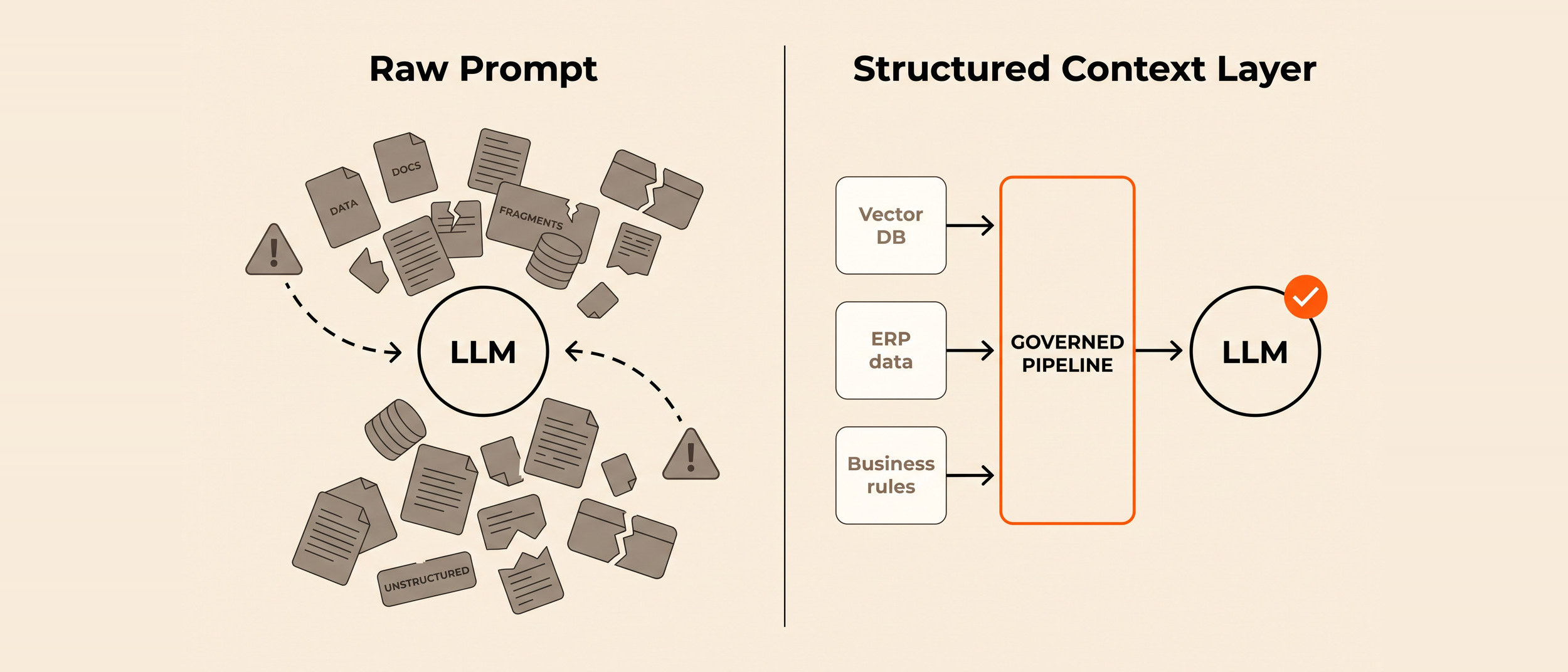
Most enterprise AI agents do not fail because the underlying model is incapable. They fail because the model is operating blind: fed raw, unstructured, or contradictory data, and expected to perform like a seasoned analyst. When a multi-step agentic workflow breaks in production, the instinct is to blame the model or escalate to a larger one. That diagnosis is almost always wrong.
The architectural gap is context. It is not the phrasing of a prompt, but the entire system governing what information reaches the model, when, and in what form. Ovidius AI builds these systems, delivering working solutions in 30 days by treating context architecture as the primary engineering problem, not an afterthought.
Without grounded, engineered context, even the most advanced LLMs suffer from severe performance degradation when executing complex enterprise workflows. The model isn't the bottleneck. The data delivery layer is.
Context engineering is the practice of designing and managing the full information environment that an AI model operates within at runtime. Prompt engineering addresses phrasing: it is single-turn, fragile, and does not scale past a handful of use cases. Context engineering addresses architecture: how data is retrieved, filtered, ranked, formatted, and injected before the model ever processes a token. In established computer science terms, this maps directly to a context model in software engineering: a structured representation of the operational environment that governs system behavior. Applied to enterprise LLMs, it is the difference between handing an assistant a sticky note and giving them secure, real-time access to the company's full filing system, policy documents, and live CRM data.
The Anatomy of Agent Failure: Why Large Context Windows Aren't Enough
Expanding the context window is a reasonable first instinct. If the model is missing information, give it more room. The problem is that volume and relevance are not the same thing. More data often means more noise. Feeding a 200K-token window with raw, unfiltered enterprise data produces a well-documented occurrence called context distraction: the model begins over-weighting irrelevant historical patterns or peripheral tool descriptions and progressively ignores its core instructions, leading to a dynamic where more data simply produces worse output.
Context clashing compounds this further in multi-step agentic pipelines. When a single un-vetted or contradictory data input enters a workflow at step two, its error signature propagates forward. By step six, the pipeline is operating on corrupted assumptions. Context poisoning, where one malformed or outdated record contaminates downstream reasoning, is particularly difficult to debug because the failure surface is wide and the root cause is invisible without semantic isolation. Managing these failure modes requires deliberate data stream separation, not a bigger window.
Raw database schemas fed directly to an LLM create a third failure class: context confusion. The model receives table names, foreign key relationships, and column aliases that carry no semantic weight, forcing it to fill the gaps with inference. That inference is where errors compound. Governed semantic models, by contrast, translate raw enterprise data into labeled, business-logic-aware representations the model can interpret without guessing; the accuracy difference between these two approaches is stark.
What Is Context Engineering? Shifting from Prompts to Architecture
A context engineer designs the runtime environment that sits between enterprise data sources and the LLM. Their work covers what data gets retrieved, how it is filtered and ranked, how it is formatted for the model's consumption, and how it is refreshed as state changes. The output is a structured context layer: not a prompt template, but a governed data pipeline that incorporates human-in-the-loop integration and makes AI hallucination prevention a systemic property rather than a per-query gamble.
A resilient, context-aware AI system rests on four operational pillars:
- Dynamic Context Retrieval: Smart RAG pipeline design that fetches only the highest-relevance data chunks at runtime, reducing noise and keeping the model focused on the task at hand.
- Semantic Context Management: Translating raw enterprise data into a governed semantic model, so the LLM interprets business logic accurately rather than inferring it from schema structure.
- Knowledge Base Integration: Connecting LLMs securely to ERPs, CRMs, and internal databases while maintaining strict data sovereignty and access controls.
- Context Compaction and Caching: Compressing context windows and caching frequent queries to reduce token overhead, control latency, and keep inference costs predictable.
Managing context dynamically across a production system also prevents memory-limit fatigue: the gradual decline that occurs when an agent accumulates stale or redundant context across long-running sessions. Implementing a dedicated enterprise context layer unifies fragmented data sources into a secure knowledge graph, giving every agent in the system a consistent, governed view of enterprise state rather than a patchwork of disconnected queries.
Enterprises do not need to spend months building custom-coded context architectures from scratch. Ovidius AI uses certified n8n pipeline expertise and a pragmatic approach to deploy production-ready, context-engineered workflows that connect directly to existing ERP and CRM infrastructure.
Implementation complexity is a real concern, and the timeline objection is legitimate. Acting as an extension of your team, Ovidius AI delivers working solutions in 30 days, bypassing months of discovery and custom coding. The clear return on investment is a measurable impact: accelerated growth, automated top-of-funnel operations, reduced manual overhead in sales workflows, and AI agents that perform reliably in production rather than in controlled demos.
Stop Prompting, Start Engineering: Build Your Context Layer with Ovidius AI
Enterprise AI agent reliability is not a model intelligence problem. It is a context engineering problem. Fragile prompts, raw data feeds, and oversized context windows are symptoms of an architecture that was never designed for production. Engineering the context layer properly, using governed retrieval, semantic translation, and dynamic state management, is what separates agents that automate real workflows from agents that generate impressive demos and break on day two.
Ready to evaluate your current AI architecture? Book an enterprise AI audit with Ovidius AI. We map your existing systems, identify context failure points, and deliver a production-ready, context-aware AI workflow within 30 days of kickoff: no months of discovery, no theoretical frameworks.