Context Layer vs Semantic Layer: What AI Agents Need From Your Data

You deployed an intelligent agent to automate a workflow. It returns answers with complete confidence. Most of those answers are wrong. When AI behaves like an incomprehensible black box, the instinct is to swap in a newer, larger LLM. That instinct is misplaced; you need a system you control, not a deeper mystery.
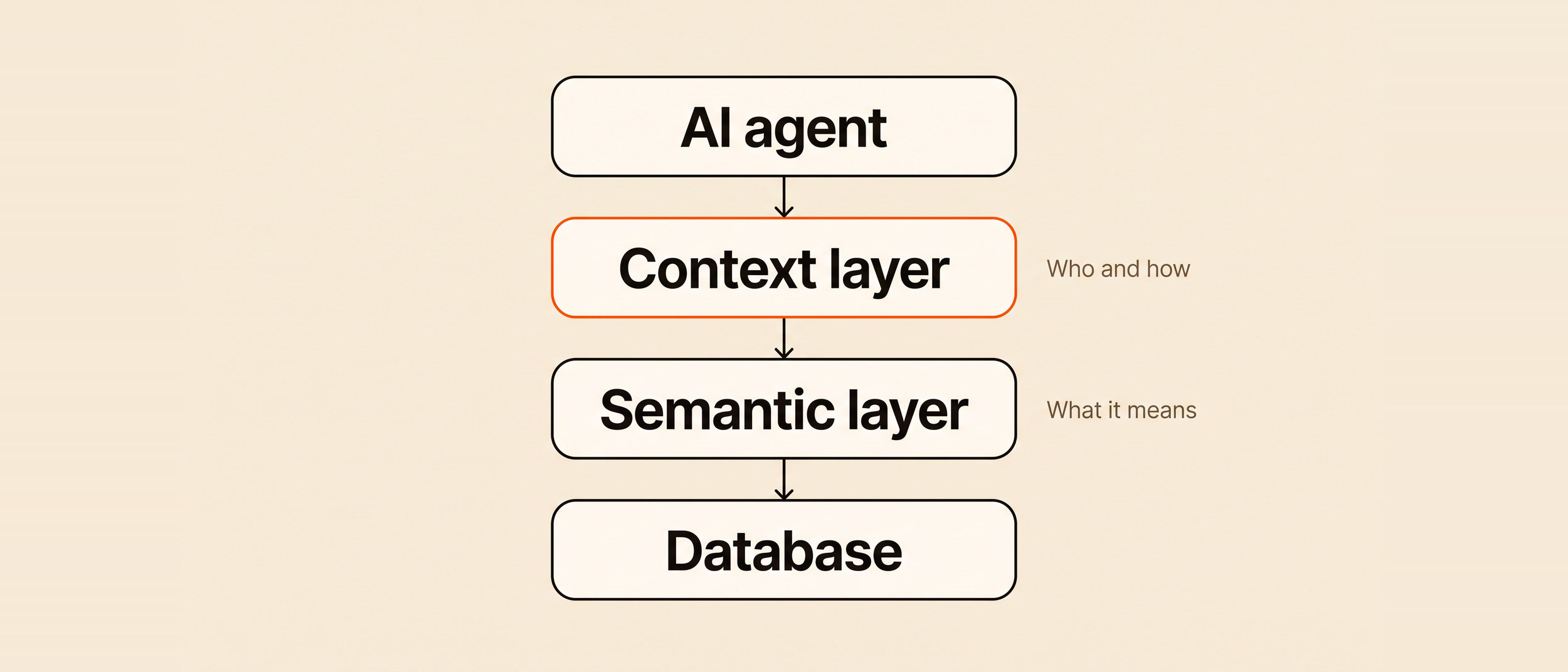
The bottleneck lives one level deeper, in your data architecture. Specifically, in the lack of two distinct structural layers that autonomous agents require to function reliably: a semantic layer that standardizes what your data means, and a context layer that governs how and by whom it can be accessed. Without both, raw LLM-to-database queries (Text-to-SQL) produce hallucinated calculations, broken joins, and security exposure that no model upgrade will fix.
Each layer solves a different class of problem. The semantic layer handles the "what": translating raw database schemas into governed business definitions so agents query clean, consistent metrics. The context layer handles the "how" and "who": modeling system-level relationships, permissions, and operational dependencies so agents execute actions safely. Combining them is not optional architecture; it is the minimum viable foundation for production-grade agentic workflows.
$12.9 Million The average annual cost of poor data quality to an enterprise organization, a figure that scales sharply when autonomous systems are consuming ungoverned data at machine speed. (Harvard Business Review)
Standardizing how context reaches agents is an active area of protocol development. The Model Context Protocol is an emerging open standard designed to connect AI agents to data sources in a structured, auditable way. Its specification defines how context is packaged and delivered across disparate systems; server implementations handle the runtime routing. For enterprise teams managing multiple data platforms, MCP provides a common interface that reduces the fragmentation problem without requiring a full infrastructure rebuild.
What Is a Semantic Layer and Why Do AI Agents Need It?
A semantic layer is a business representation of data, acting as a translation layer that maps complex database schemas to the business definitions that analysts, BI tools, and increasingly, AI agents need. Rather than exposing raw tables with cryptic column names and multi-step joins, it surfaces governed metrics: "monthly recurring revenue," "active customer," "churn rate." For an AI agent, this distinction is critical. The agent does not decode ambiguity well; it needs pre-resolved definitions or it will construct its own, often incorrectly. Think of it as giving your agent a clean, standardized map instead of letting it wander through a maze of raw database tables.
The enterprise tooling here is mature. The dbt semantic layer (developed by dbt Labs) lets data teams define metrics centrally and expose them consistently across consumers. The Snowflake semantic layer builds on Snowflake's native features, such as Horizon and Object Tagging, to support semantic modeling within the warehouse. Databricks approaches this through Unity Catalog, which defines metadata, schemas, and semantic relationships across the lakehouse. Power BI's semantic layer (the Analysis Services model underneath) has served this function for BI consumers for years. None of these platforms are a semantic layer in isolation: Snowflake is a data warehouse, Databricks is a lakehouse platform, but each provides the scaffolding to build one. The common thread is a single source of truth for metric definitions, one that both human analysts and LLM grounding pipelines can rely on without reconciliation overhead.
That said, a semantic layer alone is not sufficient for agentic workflows. It ensures metric calculations are correct and consistently defined, but it carries no operational awareness. It does not know which users or agent roles have permission to trigger a given action, what system dependencies exist between an API call and a downstream data table, or how to handle unstructured data that sits outside the governed schema. Those gaps are precisely where autonomous agents break down in production. Data needs context.
Entering the Context Layer: The Missing Piece for Agentic Workflows
A context layer manages what the semantic layer intentionally ignores: metadata management for AI agents, system-level relationships, and runtime state. Where semantic modeling for AI defines the vocabulary of your data, context management for LLMs defines the operating environment, establishing the rules of engagement. If the semantic layer is the dictionary, the context layer is the operating manual and security clearance combined.
Key capabilities of an enterprise context layer:
- Dynamic Relationship Mapping: Uses a graph database structure to map live dependencies between APIs, source code repositories, and data tables, ensuring agents understand what breaks if a given action fires.
- Native Security and Access Control: Enforces role-based access control (RBAC) directly at the data source, before the agent retrieves anything. Unauthorized data egress is blocked at the architecture level, not the application level.
- Real-Time State Management: Tracks data freshness and session history so the intelligent agent reasons over current data, not a stale snapshot from three hours ago.
- Event-Driven Updates: Automatically flags and syncs stale context without requiring manual rebuilds from the data team.
The "semantic layer vs context layer" framing implies a choice. There is no choice to make. A dependable AI knowledge base architecture requires both: the semantic layer provides structured data governance so calculations are accurate; the context layer provides operational guardrails so actions are safe. When an intelligent agent executes a workflow backed by both layers, the output is both correct and permissioned: the two failure modes that sink most enterprise AI deployments are addressed simultaneously.
Security and governance are where this architecture earns its budget justification. A context layer that enforces pre-retrieval native security policies prevents unauthorized data egress before a query ever reaches the model; the protection is structural, not dependent on prompt engineering or model-level guardrails. Emerging regulatory frameworks, including those developing around AI system transparency and record-keeping, are moving in the direction of requiring exactly this kind of documented, auditable access control. The specific compliance requirements under frameworks such as the EU AI Act remain an active area of development and cannot be stated with precision here, but the directional pressure is clear: enterprises deploying autonomous agents will need demonstrable governance at the data layer, not just at the model layer.
Upgrading to a larger LLM will not resolve the underlying problem. The data is broken. Model reasoning is not what fails when an agent returns a wrong answer against enterprise data: ambiguous schema, inconsistent metric definitions, and missing permission context are what fail. Grounding an LLM with pre-resolved semantic definitions and a structured context layer is the only path to workflows that hold up in production, across quarters, across data refreshes, and across the personnel changes that inevitably reshape enterprise data teams.
Implementing Your AI Data Strategy with Ovidius AI
Deploying a unified semantic and context layer is not a multi-year infrastructure project. Ovidius AI builds these architectures as production-ready implementations, secure, VPC-deployed, and integrated with your existing data stack, delivering working solutions in 30 days. The team (Owen, Jason, Ben, Oskar, and Maciej) acts as an extension of your team. As a certified n8n Select Partner, we build the workflow automation layer connecting your agents to governed data on a platform your engineering team can own and extend. Our systems keep your team in control with human-in-the-loop integration, letting AI handle the repetitive work while your people make the final calls.
The architecture is not a prototype; it is a working system, scoped to deliver measurable outcomes without the risk of boiling the ocean. Speed is our standard.
Ready to build a governed data foundation for your AI agents?
- Evaluate your current AI readiness: Schedule an enterprise AI audit to identify your data bottlenecks and governance gaps before they become production failures.
- Explore the architecture: Learn how Ovidius AI designs and deploys a production-ready enterprise context layer tailored to your stack.
- Automate at scale: Ovidius AI is a certified Ovidius AI n8n Agency partner, building custom automation pipelines that connect governed data to autonomous workflows.
Footnotes
[1] How Knowledge Mismanagement Is Costing Your Company Millions, Harvard Business Review. Average annual cost of poor data quality to an enterprise organization: $12.9 million.