Enterprise Knowledge Management When AI Agents Are the Readers

The Shift to Machine-Readable Knowledge
Conventional enterprise knowledge management was designed for human eyes. When a knowledge worker encounters a contradictory policy document or an outdated runbook, they apply judgment, cross-referencing institutional memory, asking a colleague, and filling the gap themselves. AI agents cannot do any of that. They consume what they are given. When that data is messy, the outputs reflect it: hallucinated answers, failed workflows, and in worst cases, unauthorized data exposure.
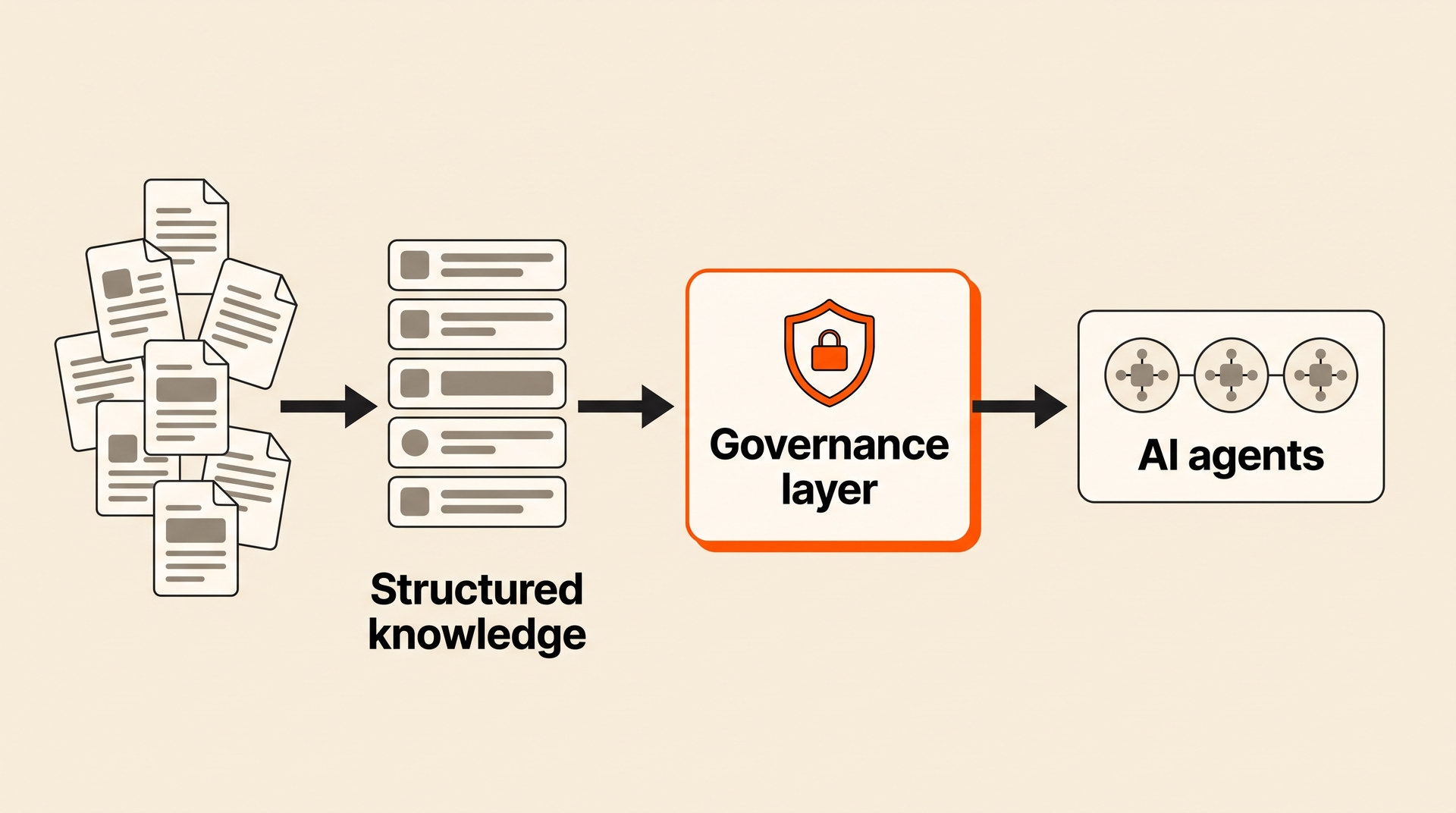
The fix is not a better search interface. It requires shifting from passive archival storage to active agentic governance: structuring internal knowledge specifically for machine consumption, with the controls and metadata that allow autonomous agents to retrieve, reason, and act without human correction at every step.
Operational note: Enterprise teams routinely spend hundreds of hours navigating siloed, legacy documentation. When AI agents inherit that same fragmented architecture, the cost is not just inefficiency, it is a complete stall in agentic productivity. No agent can execute reliably on a knowledge base that humans themselves struggle to navigate.
Deploying an AI-ready knowledge architecture means converting tacit, buried knowledge into explicit, machine-readable formats: not as a one-time project, but as a continuous operational discipline. Long-form PDFs and nested SharePoint folders are effectively opaque to an LLM trying to execute a task. Ovidius AI acts as an extension of your team to close this gap, deploying custom, self-hosted pipelines that transform fragmented internal data into structured, queryable intelligence.
1. The Architectural Shift: From Human Search to Agentic Retrieval
Keyword matching was adequate when a human was doing the filtering. An enterprise knowledge management platform built for AI agents needs something different: semantic search, vector embeddings, and multi-source arbitration that delivers precise context rather than a list of documents. The agent does not browse; it needs the answer, scoped to the task. Speed defines agentic success.
This also means moving away from proprietary platforms that lock data behind opaque APIs. Open standards and structured schemas let intelligent agents query repositories programmatically, without brittle workarounds or manual export steps.
Connecting legacy knowledge sources to agentic pipelines requires orchestration infrastructure that most enterprises do not have in place. Working with a certified n8n partner lets organizations build low-code AI workflows that bridge those legacy sources to modern agent runtimes while keeping execution and storage entirely within a private cloud, removing the data sovereignty risk that comes with third-party SaaS routing.
Mapping existing data silos, defining metadata schemas, and deploying knowledge governance frameworks is not work that benefits from a theoretical approach. Our AI consulting services accelerate this by focusing on production-ready working solutions: what needs to be structured, what needs to be deprecated, and what workflows can go live in 30 days.
2. Overcoming the Three Barriers to Agentic Knowledge Readiness
Three barriers frequently slow enterprises down when preparing knowledge systems for AI consumption. Data quality is first: outdated or contradictory documentation does not become reliable just because an agent is reading it. Access control is second: agents must respect role-based permissions, and a governance model that was adequate for human search is rarely granular enough for autonomous retrieval. Change management is third, and it is often underestimated. Shifting an organization toward continuous, structured knowledge curation requires defined ownership and process discipline, not just tooling.
Understanding How We Work shows how Ovidius AI acts as an extension of your team to map these barriers, identify high-ROI use cases, and deploy secure knowledge pipelines in 30 days.
Addressing all three barriers requires a structured set of operational controls:
- Data Quality and Deduplication: Automated workflows flag low-confidence, duplicate, or conflicting content and route it to human editors before it reaches the agent's context window.
- Granular Security and Compliance: Data governance policies enforced at the database layer ensure agents access only what their execution scope authorizes.
- Continuous Knowledge Curation: Real-time, automated knowledge lifecycle management replaces periodic manual reviews, keeping the agent's context accurate.
- Semantic Mapping and Metadata: Enriching unstructured documents with machine-readable metadata and semantic tags directly improves retrieval-augmented generation (RAG) performance.
Security cannot be retrofitted. Control is non-negotiable. When deploying enterprise knowledge management solutions at scale, the strategic imperative is self-hosting: keeping data storage, workflow execution, and encryption entirely within your own infrastructure. The specific compliance frameworks that apply will vary by industry and region, but the architectural principle holds regardless: complete control over the execution environment is what makes it feasible to integrate AI agents into high-stakes operational workflows with confidence.
Measurable outcomes are what separate a functional agentic architecture from an expensive experiment. Structured internal knowledge enables agents to handle complex routing, triage, and support tasks autonomously, while human-in-the-loop checkpoints preserve judgment where it matters. We automate repetitive data retrieval to reduce operational costs, ensuring human teams retain authority over decisions that require context no agent should hold alone.
3. The 30-Day Blueprint for Agentic Knowledge Governance
Converting your enterprise knowledge repository to support autonomous agents does not require an eighteen-month engagement. Phased process mapping, targeted schema work, and self-hosted workflow deployment can establish a secure, high-performance knowledge architecture in 30 days. If you are ready to move from pilot to production, explore our specialized AI consulting services to see how we build secure, sovereign AI workflows designed for the enterprise.
Ready to Prepare Your Enterprise Knowledge for the AI Era?
Don't let fragmented data and legacy silos stall your AI initiatives. Take action today. Schedule a structured enterprise AI audit with Ovidius AI today. Our team will evaluate your current data architecture, identify high-ROI agentic use cases, and deliver a concrete 30-day plan for building a secure, machine-readable knowledge base.
Footnotes
- Ovidius AI is a certified n8n Select Partner specializing in building custom, self-hosted AI workflows and agentic pipelines.