The 5-stage AI adoption framework: how enterprise teams scale from pilots to production
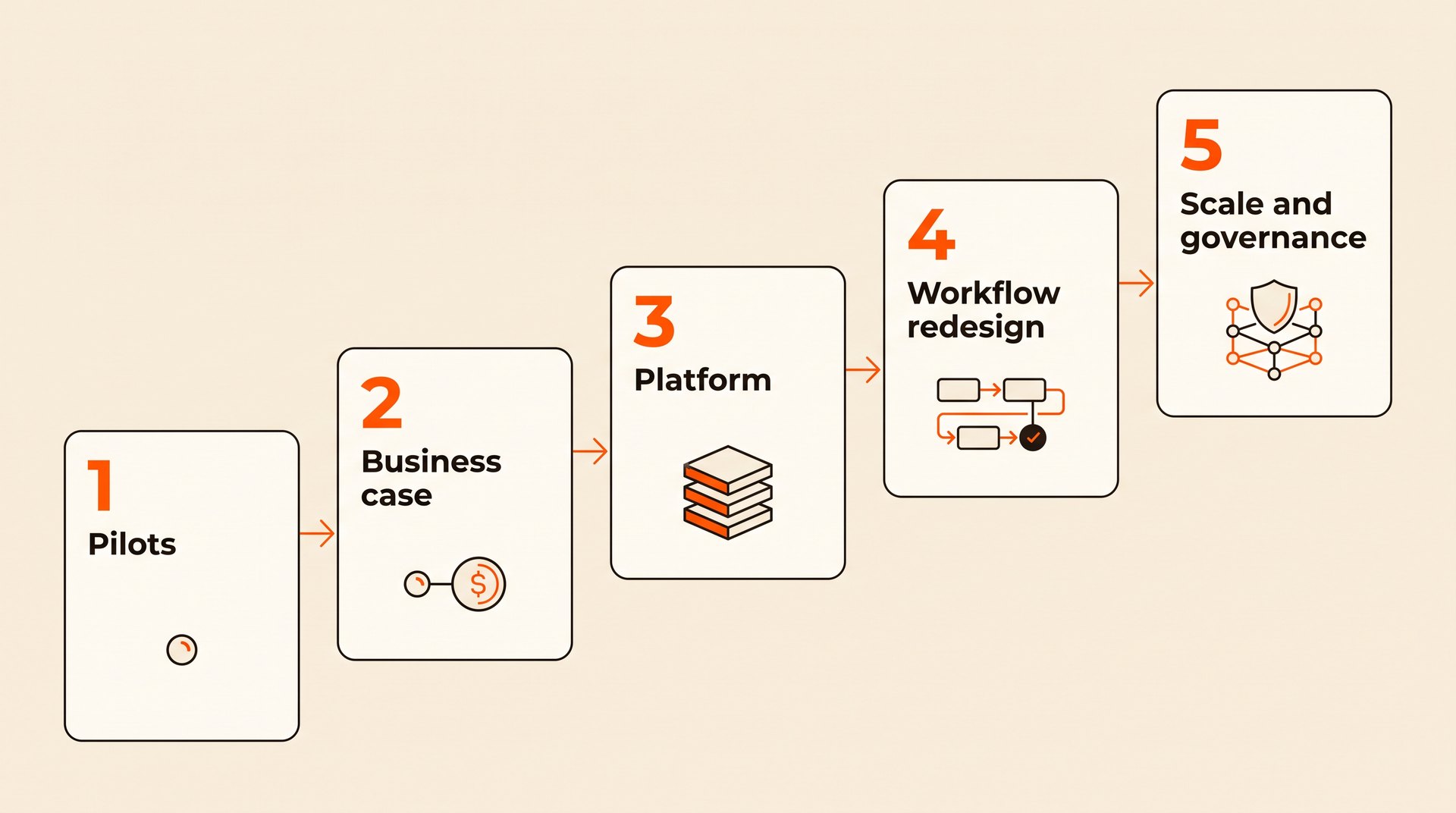
Most enterprise AI initiatives don't fail because the technology is flawed. They stall because the organization around them isn't structured to absorb them. Teams run pilots that produce promising results, then watch those results evaporate when someone tries to scale the workflow across departments. The discovery phase drags on for months. Consultants deliver frameworks that live in slide decks. Meanwhile, competitors are already in production.
What separates the organizations that achieve accelerated growth from those stuck in pilot purgatory isn't ambition: it is sequencing. A structured AI adoption framework gives enterprise teams a repeatable path from fragmented experimentation to integrated, governed, production-ready AI. It also prevents the single most expensive mistake in enterprise AI: agent sprawl, the uncontrolled proliferation of siloed tools that accumulate technical debt faster than they generate value.
Statistic Callout Inadequate technology adoption is viewed as a moderate or high risk to growth over a 12-to-24-month horizon by 53% of business leaders in North America, 50% in APAC, and 47% in Europe. (Deloitte: Family Business AI Adoption and Digital Readiness)
Approximately 88% of companies report regular AI use, yet a significant share of those initiatives never reach enterprise-wide scale (Harvard Business Review: Why AI Adoption Stalls, According to Industry Data). The gap between "we use AI" and "AI drives our operations" is where most organizations are currently stuck. Understanding why AI pilots fail is the first step, and the pattern is predictable: tools deployed without a governance structure, on top of unresolved technical debt, don't fix operational problems. They amplify them. Ovidius AI works as a dedicated extension of your team to break that cycle, delivering a working solution in weeks rather than initiating another multi-month discovery engagement.
Foundation first: stages 1 and 2 of the AI adoption framework
Stage 1: low-risk experimentation and ad hoc pilots
The instinct to launch a sweeping, organization-wide AI initiative is understandable, but it is also where the largest failures stem. MD Anderson Cancer Center put its $62 million Watson cognitive project on hold, a cautionary case that Harvard Business Review: Artificial Intelligence for the Real World documents in detail. The lesson isn't that AI is unreliable; it's that high-cost moon shots carry proportional risk. Practical cognitive projects, such as process efficiency, basic risk mitigation, and customer relationship management, yield far more dependable business value at this stage (Deloitte: Family Business AI Adoption and Digital Readiness). Think of early AI pilots as a digital apprentice: handling repetitive coordination so your team can focus on strategy. A real-world example of this in action is the agentic content pipeline built for IES Limited: a localized, high-leverage deployment that eliminated reliance on external agencies entirely.
Stage 2: strategic alignment and business case anchoring
Ad hoc pilots generate proof points. Stage 2 converts those proof points into organizational momentum. Enterprises that move past fragmented initiatives do so by anchoring their technology strategy directly to core business objectives, rather than technology roadmaps that exist in isolation (Deloitte: Family Business AI Adoption and Digital Readiness). MVPs must connect to P&L. If a workflow automation can't reduce costs and increase efficiency within a defined window, it doesn't belong in the pipeline; it belongs in a backlog. This P&L anchoring is also what secures internal funding for broader enterprise AI implementation strategy, moving the conversation from an interesting experiment to an approved budget line (Harvard Business Review: A Blueprint for Enterprise-Wide Agentic AI Transformation).
As teams deploy more localized tools across departments, a secondary bottleneck emerges: data fragmentation. Each tool accumulates its own context, its own knowledge base, its own version of the truth. A unified enterprise context layer resolves this by acting as the organization's collective memory: a single, secure source of truth that all deployed agents draw from. Without it, scaling Stage 1 pilots into Stage 2 business cases means inheriting the data sprawl those pilots created.
Integration and collaboration: stages 3 and 4 of the AI adoption framework
Stage 3: foundational infrastructure and platform integration
Nearly half of global businesses (48%) report being moderately or inadequately funded in the operational technology required to support current and future AI integrations (Deloitte: Family Business AI Adoption and Digital Readiness). That gap matters because introducing advanced AI into an environment burdened by unresolved technical debt doesn't stabilize operations; it accelerates the instability (Harvard Business Review: A Blueprint for Enterprise-Wide Agentic AI Transformation). Stage 3 addresses this directly by establishing a curated internal developer platform: governed, self-service access to tools that prevents agent sprawl before it takes root. When every team can spin up their own AI tools without a unifying infrastructure, you don't get innovation; you get redundant, siloed agents that nobody owns and everyone depends on. Silos kill efficiency.
Stage 4: workflow redesign and human-agent collaboration
Automating a broken linear process produces a faster broken process. Stage 4 requires enterprises to deconstruct legacy workflows rather than simply overlay AI on top of them (Harvard Business Review: A Blueprint for Enterprise-Wide Agentic AI Transformation). The operational shifts required to make human-agent collaboration work in practice:
- Deconstruct Legacy Workflows: Break down linear processes into modular tasks that can be distributed between humans and AI agents based on capability, not habit.
- Establish Agentic Workflows: Deploy specialized agents that autonomously orchestrate multi-system processes, acting as a tireless, always-on extension of your team.
- Maintain Human-in-the-Loop Oversight: Your team retains control, oversight, and strategic decision-making. The AI handles high-speed data processing; humans handle judgment calls.
- Decouple Value from Headcount: Shift the performance metric from manual labor hours to automated output, freeing teams to focus on relationship-building and strategy.
Data sovereignty is a legitimate concern at this stage, particularly for enterprises in regulated industries. A self-hosted n8n deployment gives teams the ability to build custom agentic AI pipelines that keep sensitive corporate data entirely within their secure perimeter, bypassing the exposure risks that come with public cloud-only tooling. For organizations where data residency is non-negotiable, this isn't a preference; it's a prerequisite.
The pace at which custom workflow automation delivers results tends to surprise organizations accustomed to multi-month implementation cycles. One client put it plainly:
"Ovidius did in weeks what we couldn't build natively in Odoo for a full year. They architected an AI-powered n8n layer on top of our ERP that now schedules well over a thousand appointments a week automatically. They are our preferred AI delivery partner.", Leadership · Dutch Odoo Implementation Partner
That outcome, over a thousand automated appointments weekly, didn't come from a theoretical framework. It came from deploying a working solution against a specific operational bottleneck, fast.
There's a genuine tension in the enterprise AI transformation debate worth acknowledging. Some strategy experts advocate for rapid, decentralized experimentation: enabling individual teams to move quickly without waiting for central approval. The counterargument, supported by Harvard Business Review: A Blueprint for Enterprise-Wide Agentic AI Transformation, is that decentralized development without a unifying strategy is precisely how agent sprawl and security vulnerabilities compound. There's no clean resolution to this tension, but a five-stage framework mitigates it by combining rapid execution at the team level with centralized governance at the infrastructure level.
Scaling and governance: stage 5 of the AI adoption framework
Stage 5: enterprise-wide scaling, governance, and talent enablement
Global AI adoption is high: 86% of surveyed businesses actively or selectively use AI technology (Deloitte: Family Business AI Adoption and Digital Readiness). But high adoption rates without structured governance create a different kind of problem: autonomous, multi-agent systems operating at scale with inconsistent oversight. The risk landscape of agentic AI is inherently complex, and most organizations are not yet equipped to manage it (Harvard Business Review: Organizations Aren't Ready for the Risks of Agentic AI). Stage 5 addresses this by building enterprise-wide governance frameworks, including risk management protocols, audit trails, and access controls, that allow AI to scale without outpacing the organization's ability to oversee it.
Overcoming the talent enablement bottleneck
Governance frameworks don't stall enterprise AI adoption at scale. People do. Employee anxieties around professional relevance and identity, specifically the concern that AI is replacing rather than augmenting, generate adoption friction that no infrastructure investment resolves on its own (Harvard Business Review: Why AI Adoption Stalls, According to Industry Data; Deloitte: Family Business AI Adoption and Digital Readiness).
Investing in digital talent development, focusing on workflow redesign rather than basic tool training, is what separates organizations that sustain AI-driven growth from those that plateau after the first wave of automation. Engaging professional AI consulting services gives your organization the structural support to navigate this entire journey: from Stage 1 pilots to Stage 5 governance, without the slow discovery phases that traditional consulting firms build their billing models around.
Ready to fast-track your AI adoption?
Don't let your AI initiatives stall in pilot purgatory. Partner with Ovidius AI to map your existing processes, identify high-leverage automation targets, and build a clear plan for measurable ROI.
Schedule your enterprise AI audit today.
If you need a self-assessment before booking, take the ten-question AI Readiness Scorecard.
Footnotes
- Harvard Business Review: Why AI Adoption Stalls, According to Industry Data
- Harvard Business Review: Artificial Intelligence for the Real World
- Deloitte: Family Business AI Adoption and Digital Readiness
- Harvard Business Review: Organizations Aren't Ready for the Risks of Agentic AI
- Harvard Business Review: A Blueprint for Enterprise-Wide Agentic AI Transformation
Written by the Ovidius AI Delivery Team. Ovidius AI is a certified n8n partner and dedicated AI consulting firm specializing in custom workflow automation, agentic pipelines, and secure enterprise AI implementations. Led by a team of expert builders including Owen, Jason, Ben, Oskar, and Maciej, Ovidius AI acts as an extension of your team to deliver working solutions and tangible results.