Kestra vs Dagster: Declarative vs. Python-Native Data Orchestration

Kestra and Dagster are both open-source orchestrators under the Apache 2.0 license, as the Kestra and Dagster repositories on GitHub state, and they differ in what a pipeline is. In Kestra a pipeline is a flow written in declarative YAML, started by a schedule or by an event such as a webhook call, new data in an external system or a message from a streaming source, and its tasks can run scripts in Python, Node.js, R, Go or Shell. In Dagster a pipeline is a set of data assets written as Python functions, and Dagster records each asset's dependencies and materialization history.
Choose Kestra when analysts and engineers who work in different languages share the pipelines, or when a small team wants one server process to run. Choose Dagster when a Python team wants every dataset defined as a tested asset, with its dbt models in the same lineage graph.
Declarative YAML against Python-native assets
A Kestra flow is a YAML file that names its triggers and its tasks. Kestra's README calls this a declarative YAML interface, where you "define workflows using a simple configuration in the built-in code editor". The flow is configuration rather than a program, so engineers review it like code and analysts can read what it does, while the tasks inside it run scripts in the languages Kestra supports: "Python, Node.js, R, Go, Shell, and others".
Branching and loops stay in the YAML. Kestra's flowable tasks "control orchestration logic: branching, looping, and parallelizing work". If and Switch choose a branch, Parallel starts child tasks at the same time, and Subflow starts a child execution of another flow.
Dagster starts from the data rather than the task. In Dagster's documentation, "An asset definition is a description, in code, of an asset that should exist and how to produce and update that asset", and the usual way to write one is a Python function with the @dg.asset decorator. Asset definitions know their dependencies, so Dagster draws them as an asset graph, and its asset catalog shows each asset's materialization history: every time its function ran and saved its results.
For a Python team that model fits the daily work. One command starts a full local deployment, the Dagster webserver and daemon together. An asset with no arguments can be called directly in a unit test and run with pytest. The dagster-dbt library represents dbt models as assets in Dagster, so the dbt models and the Python assets share one lineage graph.
Each model puts the complexity in a different place. A YAML flow that needs runtime logic leans on flowable tasks and scripts, and a Python codebase asks everyone who changes a pipeline to handle dependency management, virtual environments and code review.
Deployment and self-hosting
Both run on your own infrastructure. Kestra's Docker Compose file starts Kestra with a PostgreSQL database as "a standalone server, with all architectural components running in one JVM". Those components are the executor, worker controller, worker, scheduler, webserver and indexer, and the database holds both the queue and the repository of flows, executions, logs, triggers and secrets. A Kafka and Elasticsearch backend for higher throughput comes with the Enterprise Edition.
A Dagster open-source deployment runs the webserver, the daemon and one or more code location servers as long-running services. The webserver serves the user interface, the daemon "operates schedules, sensors, and run queuing", and each code location server serves your Dagster definitions, with the database managed by the Dagster instance (Dagster's deployment architecture). The gap is widest at the first setup and when something fails, since a Kestra standalone server is one process to watch.
Each also sells a managed product on its open-source engine. Kestra lists Kestra Cloud, priced by usage, and Kestra Enterprise, priced per instance, which runs on your own infrastructure (Kestra pricing) and adds multi-tenancy, action-based RBAC, identity-provider integration and audit logging (Kestra's architecture). Dagster+ is "a managed orchestration platform built on top of Dagster's open source engine", in a Serverless or a Hybrid form, with Solo, Starter and Pro plans on Dagster's pricing page.
Both can start runs on events. Kestra's triggers start a flow on a cron schedule, when an upstream flow finishes, on an inbound HTTP request, when new data is detected in an external system, or with millisecond latency when an event arrives from a streaming source. Dagster starts runs from schedules and sensors, and its sensors trigger runs on events "like the arrival of a new file or a change to an external system".
| Kestra | Dagster | |
|---|---|---|
| Pipeline | a flow written in declarative YAML | a set of data assets written as Python functions |
| Starts runs | started by a schedule or by an event | from schedules and sensors |
| Code | Python, Node.js, R, Go, Shell, and others | the usual way to write one is a Python function with the @dg.asset decorator |
| Database | the database holds both the queue and the repository | the database managed by the Dagster instance |
| Deployment | Docker Compose setup runs a standalone server with every component in one JVM | open-source deployment runs a webserver, a daemon and one or more code location servers |
| License | Apache 2.0 license | Apache 2.0 license |
| Managed product | Kestra Cloud | Dagster+ |
Which one should your team choose?
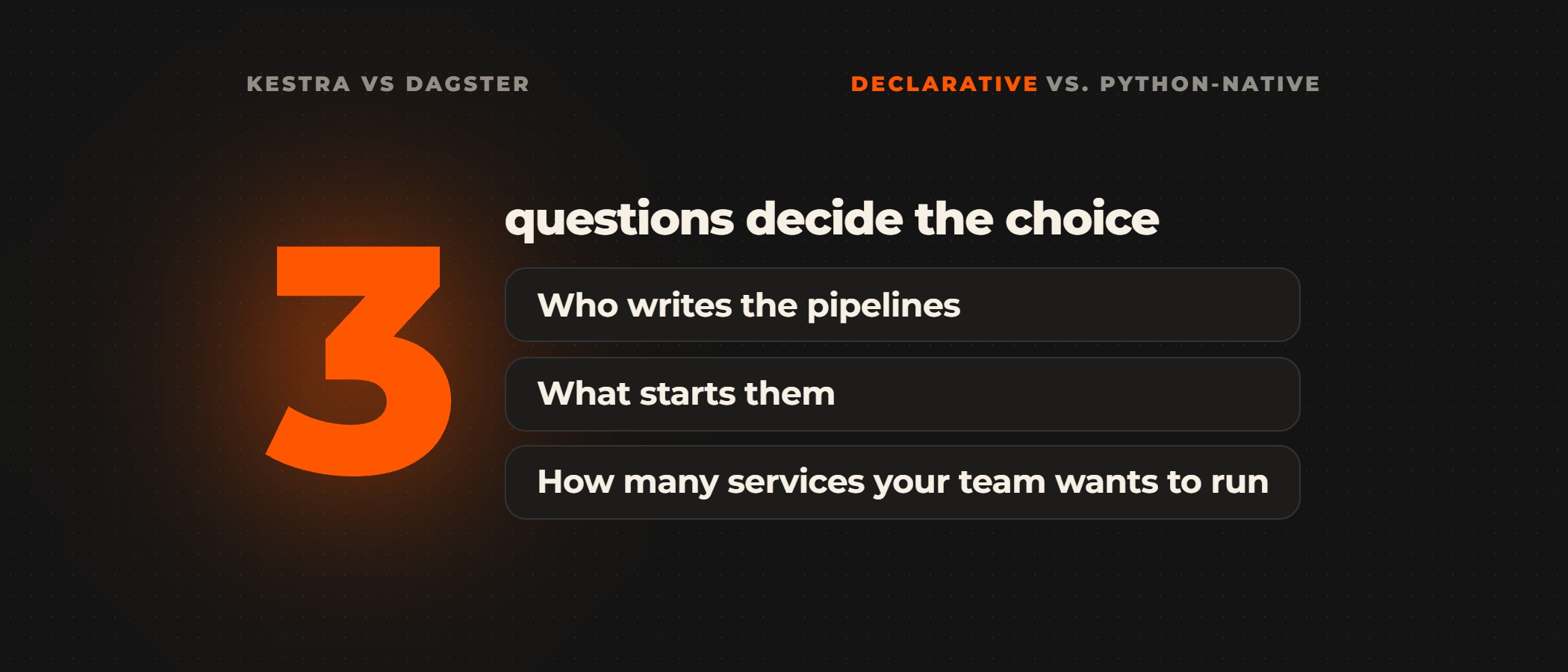
Three questions decide the choice: who writes the pipelines, what starts them and how many services your team wants to run.
Automation between business apps is a separate layer. Where a stack needs it, n8n handles automation between apps, and Kestra handles the data and AI pipelines behind it.
How Ovidius runs a Kestra implementation
We design, deploy and scale Kestra workflows that connect your data and AI systems, then hand your team a platform it can run. A project starts with architecture scoping and environment setup, translates legacy scripts or Airflow DAGs into declarative YAML with the business logic intact, connects your APIs, webhooks and real-time listeners, and ends with dashboards, alert thresholds and runbooks your team owns. Every build is tested in staging before it goes live, and scoping sets the timeline.
Frequently asked questions
What is the difference between Kestra and Dagster?
Kestra defines a pipeline as a flow written in declarative YAML, started by a schedule or by an event, with tasks that run scripts in Python, Node.js, R, Go or Shell. Dagster defines a pipeline as data assets written as Python functions and records each asset's dependencies and materialization history. Both are open source under the Apache 2.0 license.
Is Kestra open source?
Yes. Kestra is licensed under the Apache 2.0 License, and its open-source edition, Kestra Core, runs with no limits on flows or executions, in Kestra's own words on its pricing page. Kestra Enterprise is a separate commercial product on the same core that adds multi-tenancy, action-based RBAC, identity-provider integration and audit logging.
Is Dagster free to self-host?
Yes. Dagster's open-source engine is Apache 2.0 licensed, and you run it yourself as a webserver, a daemon and one or more code location servers. Dagster+ is the paid managed platform built on that engine, offered in a Serverless or a Hybrid form, with Solo, Starter and Pro plans.
Can Kestra run Python code?
Yes. A Kestra flow is written in YAML, and its tasks can run scripts in Python, Node.js, R, Go, Shell and other languages. A team keeps the Python it already has inside the tasks, while the flow around it stays configuration that analysts can read and engineers review like code.
Does Dagster work with dbt?
Yes. The dagster-dbt library represents dbt models as assets in Dagster. In the asset graph, each upstream asset is connected to the dbt models that reference it, so the dbt models and the Python assets share one lineage graph.
Which is easier to self-host, Kestra or Dagster?
Kestra starts as one process. Its Docker Compose setup runs a standalone server with every component in one JVM on a PostgreSQL database. A Dagster open-source deployment runs a webserver, a daemon and one or more code location servers as separate long-running services. Both run on your own infrastructure, and Kestra adds a Kafka backend in its Enterprise Edition.
Is Kestra already in your architecture plan?
A senior partner runs the call, and if Kestra is already in your architecture plan, we skip another evaluation and go straight to scoping. Schedule a consultation and start with the pipeline that breaks most often.


