MLOps vs LLMOps: What Changes When You Run Language Models

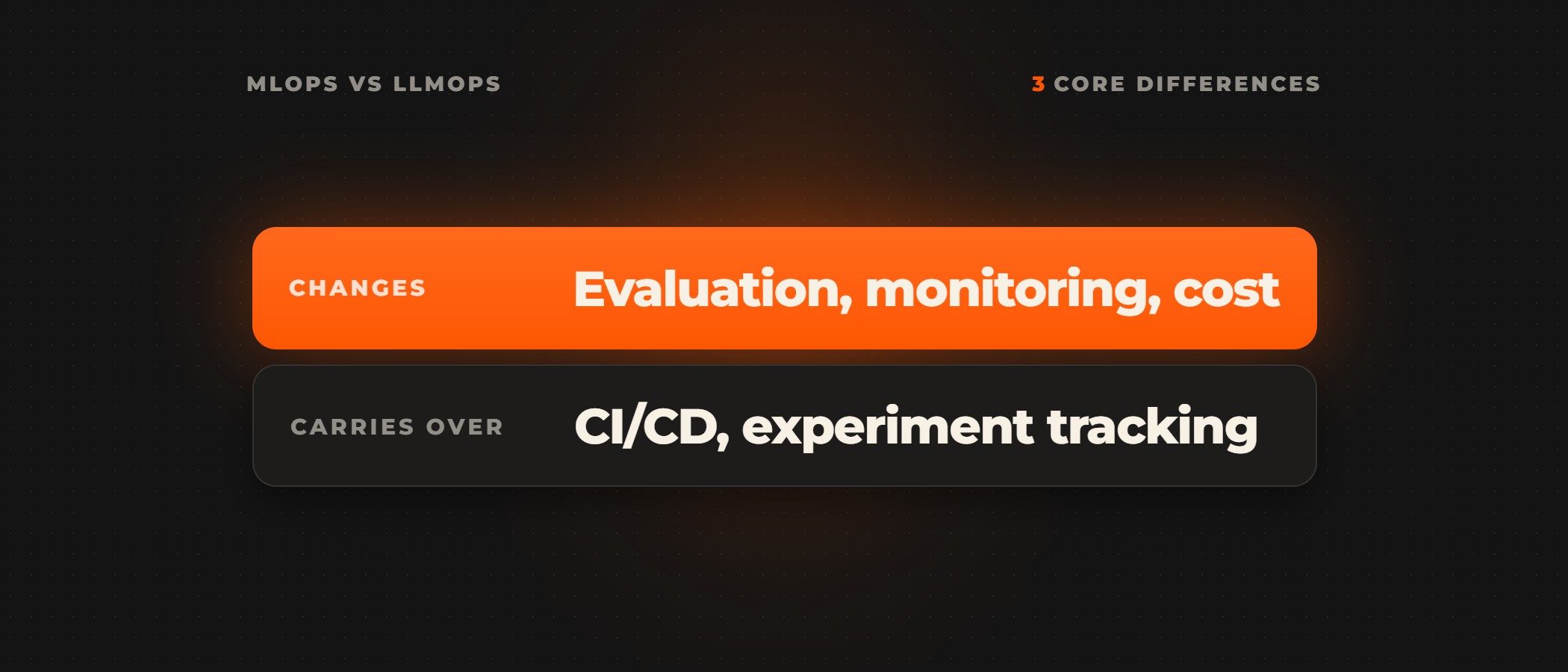
When you run language models, the tooling your team already trusts, such as CI/CD pipelines, experiment tracking, and deployment registries, carries over. What changes is what you build on top of it: the failure modes, the evaluation logic, and the cost structure. Teams built to manage deterministic, structured-data models now govern systems that can produce a different answer each time they run. The gap shows when a proof-of-concept that ran well in a notebook collapses under production load, or when a model that scored well on internal benchmarks starts generating outputs nobody can defend to a client.
Traditional MLOps was designed around structured data and tasks with measurable ground truth, including churn prediction, fraud classification, and demand forecasting. When you move to large language model operations, the inputs become natural language prompts, the data artifacts become embedding vectors, and the outputs resist any single numerical metric. The shift changes how teams allocate engineering time, how they define "working," and how they price infrastructure. An AI pilot on your own systems shows all three before the production budget is spent.
1. What is LLMOps and How It Changes Traditional MLOps
LLMOps is the operational discipline for managing large language models across their full production lifecycle, from prompt design and retrieval augmentation through deployment, monitoring, and continuous evaluation. It is a specialization within MLOps, not a replacement for it. The foundational practices, including version control, automated testing, and deployment pipelines, stay as they are. What LLMOps adds is a layer of tooling and process built for the artifacts and failure modes that foundation models introduce.
The most immediate difference shows up in where engineers spend their time. In an LLMOps workflow, the pre-trained foundation model is the starting point. That shift trades one class of complexity for another.
Prompt versioning is the practice LLMOps adds to version control. A single-sentence change to a system prompt can alter output tone, factual grounding, and refusal behavior simultaneously. Without disciplined prompt versioning and regression testing, those changes propagate silently into production, where they are hard to audit after the fact.
| Traditional MLOps | LLMOps | |
|---|---|---|
| Engineering effort | feature engineering, hyperparameter search, and retraining schedules | prompt pipelines, retrieval-augmented generation architecture, and fine-tuning decisions |
| Versioned artifacts | code and data are the primary versioned artifacts | the system prompt is a first-class artifact with the same production weight as application code |
2. The Core Differences: Evaluation, Monitoring, and Cost Models
Evaluation, monitoring, and cost structure are where the split between MLOps and LLMOps is sharpest, and each needs an approach built for language models.
| Traditional MLOps | LLMOps | |
|---|---|---|
| Evaluation Metrics | quantitative metrics with clear mathematical definitions: accuracy, F1, and ROC-AUC | hybrid frameworks that combine golden dataset comparisons with automated LLM-as-a-judge scoring |
| Monitoring and Safety | Numerical prediction drift | hallucinations, prompt injection attempts, and toxic output generation |
| Cost and Infrastructure | the heaviest spend is front-loaded into training | inference costs accumulate with every API call, and vector search operations add a variable layer on top |
LLMOps evaluation has no equivalent shortcut. In LLM-as-a-judge scoring, a second model assesses whether an output is grounded in the source context it was given. No single metric resolves the subjectivity, so the goal is a defensible, reproducible signal.
The LLMOps failure modes do not surface in standard observability dashboards. Where a model can confidently assert something its context does not support, active guardrails and human-in-the-loop checkpoints belong on any workflow where the output carries reputational or legal weight.
LLMOps flips the cost model. Training the foundation model is the provider's cost, and the spend is ongoing and driven by usage, so cost governance belongs in the architecture from the start. The AI agent cost estimator shows what one run costs on each model.
Put three LLMOps practices in place before scaling: semantic caching layers to reduce redundant inference calls, rate limiting at the prompt level, and human-in-the-loop verification for any automated workflow touching customer-facing outputs. Hold LLM integrations to the same accountability structures you use for application code.
An enterprise that runs both kinds of model needs traditional MLOps and LLMOps running in parallel. A practical example: a traditional classifier routes high-priority support tickets, and an LLM-powered workflow drafts the personalized response. Keeping those two systems under a unified orchestration layer prevents operational silos from forming and reduces the maintenance surface as both pipelines evolve independently.
Ovidius AI works inside this transition as a senior team working as an extension of yours. Whether the immediate need is an evaluation pipeline, a vector database retrieval architecture, or guardrails for an agentic workflow, the team that builds it also monitors and improves it after go-live, which is what takes a promising prototype to a system that earns trust in production.
3. Transitioning Safely to Production-Grade LLMOps
Moving language models from a local environment into enterprise production is a shift from experimental coding to disciplined engineering. The teams that make it treat prompt management, non-deterministic evaluation, and variable inference costs as first-order engineering problems from day one. That discipline extends what already works, with the right operational layer on top.
Frequently asked questions
Is LLMOps a replacement for MLOps?
No. LLMOps is a specialization within MLOps: version control, automated testing, and deployment pipelines stay, and LLMOps adds a layer of tooling and process for the artifacts and failure modes that foundation models introduce. It covers the full production lifecycle of a language model, from prompt design and retrieval augmentation through deployment, monitoring, and continuous evaluation.
How do you evaluate a language model in production?
With a hybrid framework, because the outputs resist any single numerical metric. Traditional MLOps relies on accuracy, F1, and ROC-AUC, which have clear mathematical definitions. For a language model, teams combine golden dataset comparisons with automated LLM-as-a-judge scoring, where a second model assesses whether an output is grounded in the source context it was given. The goal is a defensible, reproducible signal.
Why do system prompts need version control?
The system prompt carries the same production weight as application code. A single-sentence change to it can alter output tone, factual grounding, and refusal behavior at the same time. Without prompt versioning and regression testing, those changes propagate silently into production, where they are hard to audit after the fact.
What should LLMOps monitoring watch for?
Hallucinations, prompt injection attempts, and toxic output, the failure modes that standard observability dashboards do not surface, beside the numerical prediction drift that MLOps already monitors. Where a model can assert something its context does not support, active guardrails and human-in-the-loop checkpoints belong on any workflow whose output carries reputational or legal weight.
How is the cost of running a language model different?
The spend is ongoing and driven by usage. With a foundation model, training is the provider's cost, while inference costs accumulate with every API call and vector search operations add a variable layer on top. Because of that, semantic caching and rate limiting at the prompt level belong in the architecture before you scale.
Can MLOps and LLMOps run side by side?
Yes, and an enterprise that runs both kinds of model needs them to. For example, a traditional classifier routes high-priority support tickets and an LLM-powered workflow drafts the personalized response. Keeping the two under a unified orchestration layer prevents operational silos from forming and reduces the maintenance surface as both pipelines evolve independently.
Ready to Scale Your LLM Workflows?
At Ovidius AI, we work as an extension of your team to build, deploy, and monitor production-grade AI systems. We scope each build and tell you before you commit; for a well-scoped first build, 30 days gives a sense of pace.
Contact the Ovidius AI team to book a discovery call and map out your move to production-grade LLMOps.


