ai safety training for enterprise teams

[SEO TITLE]AI Safety Training: The Enterprise Guide to Secure Deployment[/SEO TITLE] [Meta Descritpion]Discover how to implement rigorous ai safety training for your enterprise. Learn to mitigate risks, align with NIST frameworks, and deploy secure AI workflows.[/Meta Descritpion]
What you'll take away from this guide:
- The Safety Gap: Why AI capabilities are outpacing organizational risk management, and how to close the gap.
- Dual-Track Strategy: Segmenting training into technical defense for engineering teams and behavioral hygiene for business units.
- NIST Alignment: Aligning with the NIST AI Risk Management Framework (AI RMF 1.0) to govern, map, measure, and manage risks.
- Technical Guardrails: Why human training must be reinforced with automated, built-in system safeguards.
If your teams are running generative AI in production workflows without documented guardrails, you are carrying liability that most legal and compliance functions haven't fully priced yet. The pressure to ship AI-powered features, automate customer-facing processes, and cut operational overhead is real, and it is not slowing down. Neither is the exposure. Enterprise AI safety training is not a checkbox exercise or a drag on velocity. Treated correctly, it is the mechanism that lets organizations move faster with confidence rather than slower out of fear.
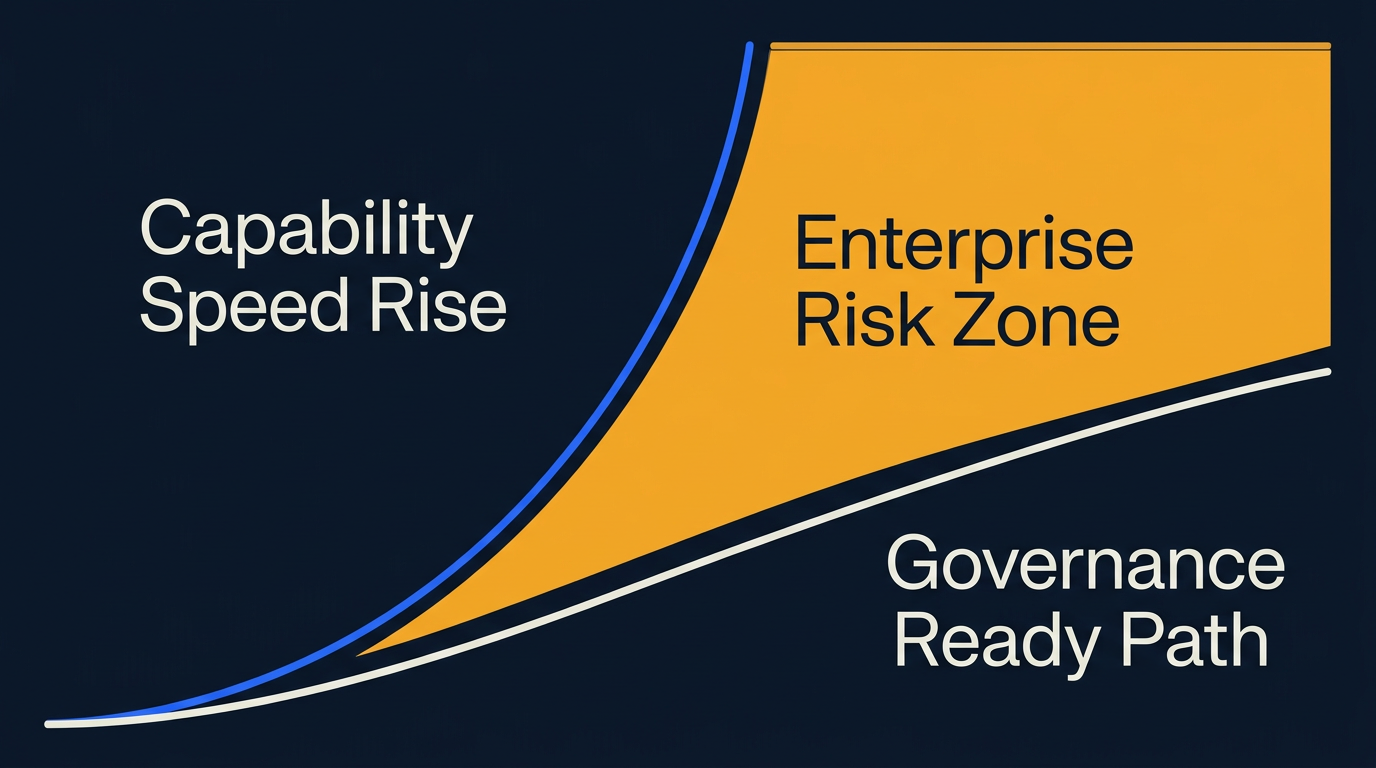
AI safety, as a discipline, covers the shared practices and principles designed to ensure that artificial intelligence technologies are developed and deployed in ways that benefit humanity while minimizing potential harms and negative outcomes (IBM Think on AI Safety). That definition sounds abstract until you map it against an actual enterprise stack: a CRM enriched by an LLM with access to customer PII, an autonomous scheduling agent touching ERP data, a support bot trained on internal knowledge bases. As organizations move from bounded generative AI pilots toward agentic systems that act with limited human oversight, the risk surface expands in ways that standard IT governance wasn't designed to address. AI capabilities are advancing faster than organizational capabilities, which transforms AI adoption from a technical problem into a leadership and organizational transformation challenge (IBM Think Insights on AI Adoption Challenges).
The Enterprise AI Safety Gap
Organizations have been asking whether their AI deployments are safe, and the answer, across a significant portion of the market, is no. According to IBM's research on AI safety, 44% of surveyed organizations have already reported adverse outcomes from their AI use, including inaccuracies and cybersecurity incidents. That is not a fringe outcome. Nearly half of enterprises deploying AI have encountered material failures.
What makes that figure harder to dismiss is the context behind it. Despite these operational risks accumulating across the industry, safety has historically been treated as a secondary concern, with only 3% of technical research focused on making AI safer. The engineering investment has gone overwhelmingly into capability, not containment. Enterprises are therefore inheriting systems built under a research culture that deprioritized the very problems they are now trying to manage.
The commercial stakes extend beyond internal operations. Public sentiment toward AI is measurably skeptical: 52% of Americans report they are more concerned than excited about the increased use of artificial intelligence. For North American enterprises with consumer-facing products or regulated client relationships, that skepticism translates directly into reputational and commercial risk. A publicized AI failure, such as a data leak, a biased automated decision, or a hallucinated output delivered to a customer, does not just create a compliance incident. It erodes the trust that enterprise sales cycles depend on. AI literacy and safety training for employees, in this context, is as much a commercial safeguard as it is a technical one.
The Dual-Track Training Strategy
A single, undifferentiated training program applied across an enterprise tends to satisfy neither audience. Security engineers sitting through prompt hygiene basics disengage. Business analysts confronted with red teaming concepts without context disengage differently. Both tracks lose value. Effective ai risk management training for employees requires two structurally distinct tracks that share a governance backbone but differ significantly in content and depth, ensuring that both technical builders and business users receive relevant, actionable guidance.
- Technical Training Track: Designed for developers, security teams, and ML engineers. Covers advanced threat vectors: red teaming methodologies, defending against prompt injection attacks, identifying and mitigating data poisoning, and managing multi-turn adversarial interactions. This track treats AI systems as attack surfaces and trains engineers to stress-test them accordingly.
- Behavioral Awareness Track: Designed for non-technical business teams. Focuses on prompt hygiene, the discipline of verifying AI-generated outputs for hallucinations before acting on them, and the organizational policy around unapproved "shadow AI" tools. The goal is not to make business users into security engineers; it is to make them reliable last-mile controls.
- Cross-Functional Alignment: The gap between these two tracks is where most enterprise governance frameworks fracture. Risk policies written by security teams often fail in practice because they weren't designed with operational workflows in mind. Bridging technical and compliance teams to produce enforceable, workable policy is not a soft skill; it is a structural requirement of any mature AI governance program.
Aligning with the NIST AI Risk Management Framework
The NIST AI Resource Center provides the most operationally useful governance scaffold available to North American enterprises, particularly those with federal contracts or regulated industry exposure, offering a standardized approach to mitigating deployment liabilities. The AI Risk Management Framework (AI RMF 1.0) organizes risk management around four core functions, not as a linear checklist, but as an ongoing operational stance:
- Govern: Establish the organizational culture, policies, roles, and accountability structures that make risk management possible in practice. Without this layer, the other three functions have no institutional home. Structure dictates success.
- Map: Identify and document the specific context, technologies, and potential failure modes associated with each deployed AI system. This is where abstract risk categories get translated into concrete use-case inventories.
- Measure: Analyze and benchmark AI risks using both quantitative and qualitative methods. This includes ongoing evaluation of model behavior, not just pre-deployment testing, a distinction that matters considerably for systems that drift over time.
- Manage: Implement continuous monitoring, response protocols, and technical controls to mitigate identified risks in live workflows. The framework treats management as an active, iterative function rather than a one-time deployment gate.
The NIST AI RMF is currently undergoing revision, which means compliance targets for some sectors remain partially unresolved. Organizations aligning to it now should build their governance structures with that flexibility in mind; the framework's principles are stable even as specific guidance evolves.
📋 Download the Enterprise AI Safety Policy & Launch Checklist Establish a resilient governance framework and catalog your organization's AI use cases with a structured, ready-to-deploy checklist built for IT leaders and compliance officers implementing ai safety guidelines for workplace adoption. [MISSING: downloadable asset]
Mitigating Vulnerabilities in Enterprise Workflows
The threat categories that enterprise AI deployments face are not hypothetical. Algorithmic bias producing discriminatory outputs in hiring or lending workflows, data privacy breaches through inadvertent model memorization, loss of operational control over autonomous agents, and direct cybersecurity attacks, including prompt injections, jailbreaks, and data poisoning, are documented, recurring failure modes (IBM Think on AI Safety). Training programs for responsible AI use in business must teach employees to recognize and escalate these weaknesses before they compound into reportable incidents. Awareness without a clear escalation path is insufficient; the training must be paired with defined reporting channels and response procedures.
Traditional IT security frameworks are structurally mismatched to this problem. AI is different. They were designed for deterministic software: systems with predictable inputs, bounded logic, and auditable outputs. AI introduces probabilistic models whose behavior can shift under adversarial prompting, distributional drift, or subtle changes in context, none of which a conventional firewall or access management system can intercept. The controls that protect a relational database do not protect an LLM with tool-calling capabilities. The risk is real. Enterprises that assume their existing security posture covers AI deployments are carrying a gap they haven't measured yet.
"Ovidius.ai felt like a true extension of our engineering team. They migrated our entire CRM routing and automated our lead triage in self-hosted n8n in just two weeks. They saved us thousands of dollars in monthly SaaS fees and countless manual hours. If you are looking for an artificial intelligence consulting firm that builds instead of just talking, hire Ovidius." CTO, Mid-Market FinTech Enterprise
Shifting from Awareness to Technical Guardrails
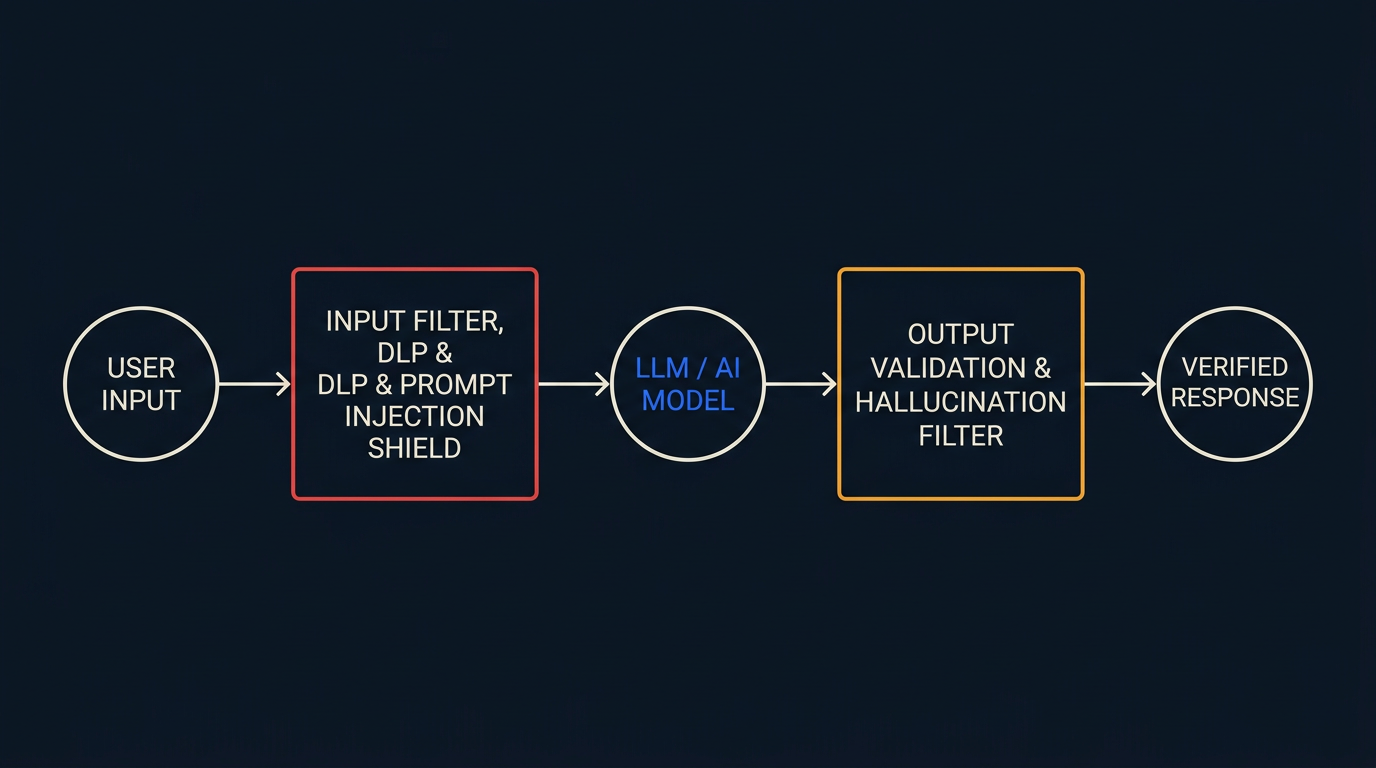
Enterprise AI compliance and security training is necessary. It is not sufficient. Even a well-trained workforce produces errors: employees paste sensitive data into the wrong tool under deadline pressure, misconfigure a prompt template, or fail to recognize a subtly adversarial input. Relying on perfect human behavior as the primary safety control is a design choice with a known failure rate. The more resilient strategy is to engineer technical guardrails directly into the AI system's architecture, so that the system's structure enforces constraints that training alone cannot guarantee.
In practice, this means implementing automated input filtering with data loss prevention (DLP) logic that intercepts sensitive content before it reaches the model, context isolation that prevents cross-contamination between user sessions or data domains, and least-privilege data access layers that restrict what the model can retrieve or act on based on the requesting user's role. Output validation pipelines, which are filters that evaluate model responses for hallucinations, policy violations, or sensitive disclosures before they surface to the user, add a second enforcement layer that operates independently of employee behavior. When Ovidius AI deploys enterprise AI workflows, these controls are built into the architecture from the initial design phase, not retrofitted after a compliance audit surfaces a gap. The audit-then-patch cycle is expensive; the build-it-in approach is not. Build securely first.
🔒 Deploy Secure AI Workflows with Built-In Technical Guardrails Ready to move from AI pilot to production-ready deployment without exposing your organization to data leaks or compliance failures? Schedule an AI Deployment & Safety Guardrails Consultation with the engineering team at Ovidius AI, and get to working, secured AI in under 30 days. Contact Ovidius AI to Schedule Your Consultation
Building a Responsible AI Culture
Governance frameworks and technical controls create the conditions for safe AI use. Culture determines whether those conditions hold when no one is watching. The organizations that sustain responsible AI practices over time are the ones that treat safety as an operational norm rather than a compliance event; that requires deliberate, ongoing investment in the people and processes that carry it forward.
- Establish Feedback Loops: Create clear, low-friction channels for employees to report model drift, unexpected outputs, or suspected hallucinations. If reporting feels bureaucratic, it won't happen consistently enough to be useful.
- Appoint AI Safety Champions: Designate accountable leaders within each business unit to monitor compliance with corporate AI safety best practices and serve as the first point of contact for emerging concerns. This distributes governance responsibility without diffusing accountability.
- Conduct Continuous Upskilling: AI governance training for business teams requires regular revision. The threat landscape shifts, new tools enter the stack, and regulatory guidance evolves. A training program that was current eighteen months ago may be materially incomplete today.
- Define Clear Accountability: Establish explicit ownership for automated decisions, particularly in customer-facing or regulated workflows. When an AI system produces a harmful output, the question of who is responsible cannot be left to post-incident interpretation.
📋 Enterprise AI Safety Policy & Launch Checklist Use this lead-generation form to download the structured checklist for IT and compliance leaders building out their AI governance programs. [MISSING: downloadable asset]
The Role of Leadership in AI Transformation
Workforce readiness programs stall when executive sponsorship is inactive. The organizations that have moved from AI experimentation to disciplined, scalable deployment share a common pattern: senior leadership treated AI adoption as a transformation initiative, not a technology procurement decision. That distinction matters because the hard problems, including cross-functional policy alignment, change management, and accountability structures for automated decisions, cannot be resolved at the team level. They require authority and sustained attention from above. Leadership drives adoption.
AI adoption is, at its core, a leadership and organizational transformation challenge (IBM Think Insights on AI Adoption Challenges). Executives who frame AI safety as a strategic priority, rather than as an administrative constraint imposed by legal or IT, create the organizational conditions where safety and velocity reinforce each other instead of competing. That framing also changes how employees engage with training: when leadership visibly treats governance as consequential, compliance rates and reporting quality improve measurably. The inverse is equally true.
The questions below address the specific governance and risk scenarios that enterprise IT and compliance teams encounter most frequently when standing up AI safety programs.
Frequently Asked Questions About AI Safety Training
Why is general employee training necessary if we have IT security?
Traditional IT security protects systems from unauthorized external access. It cannot prevent an authorized employee from pasting a customer contract into a public generative AI tool, or from using an unapproved AI application that routes data through an external server. General employee training ensures that business teams understand prompt hygiene. It also covers the organizational risks of shadow AI, closing the exposure gap that technical controls alone leave open at the user level.
How does the NIST AI RMF 1.0 apply to commercial enterprises?
The framework was developed by a federal agency, but its structure is deliberately non-prescriptive and broadly applicable. For commercial organizations, it provides a principled scaffold to govern, map, measure, and manage AI risks, without mandating specific tools or architectures. Aligning to it helps enterprises demonstrate due diligence to clients, insurers, and regulators, and it provides a common vocabulary for cross-functional risk conversations that would otherwise stall in definitional disagreements.
What is the difference between generative AI safety and agentic AI safety?
Generative AI safety is primarily concerned with managing static outputs: preventing data leaks, filtering harmful content, and validating factual accuracy. Agentic AI safety addresses a structurally different problem: autonomous systems that take sequences of actions, call external tools, and operate across extended timeframes with limited human checkpoints. The governance requirements for an agent that can modify records, send communications, or trigger financial transactions are categorically more demanding than those for a text-generation endpoint.
How do we prevent shadow AI usage in our workflows?
The most durable approach is to reduce the friction gap between approved and unapproved tools. When employees reach for unauthorized AI applications, it is usually because the approved alternatives are slower, less capable, or harder to access. Pairing clear ai safety guidelines for workplace adoption with the deployment of centralized, enterprise-grade AI tools, specifically those with built-in data protection, role-based access controls, and audit logging, addresses the root cause rather than just the symptom.
Why is post-training alignment alone insufficient for AI safety?
Post-training alignment methods are brittle in ways that matter operationally. Models can appear fully aligned during standard evaluation and then fail under minor distributional shifts or targeted adversarial prompting. Research has found that unsafe behaviors embedded during pretraining are extremely difficult to remove through post-hoc fine-tuning (IBM Think on AI Safety). This is why a multi-layered approach, combining pretraining controls, continuous evaluation, and external technical guardrails, is more reliable than alignment work applied after the fact.
Building a secure enterprise AI environment is a coordinated effort across leadership, engineering, and business units, and none of those layers can substitute for the others. Training programs establish the cultural foundation; they create a workforce that understands the risks, recognizes failure modes, and knows how to escalate. But the architecture of the AI system itself determines whether that training is the last line of defense or simply one layer in a properly designed stack. When security is engineered into the system from the outset, through input filtering, output validation, context isolation, and least-privilege access, the organization's exposure doesn't hinge on every employee making the right call under pressure. That is the difference between a governance program and a genuinely secure deployment.
🚀 Don't Let Compliance Concerns Stall Your AI Initiatives Partner with Ovidius AI to deploy secure, high-ROI workflows in under 30 days. Explore our AI consulting services to build custom solutions with engineered-in technical guardrails, and move from pilot to production with confidence.